Friday, 25 May 2018

Not invited: a story


(This is a story, but it is factual to the extent that something like this is entirely possible given the current legal status in parts of the United States as regards child marriage)
*****************************************************
I was not invited to the wedding. I do not know anyone who was. Nobody I spoke to afterwards had any idea that a wedding was going to take place – certainly none of her friends or my fellow teachers at Cedar Vale High School, Colorado, where Jasmine was a pupil. One day she was in my class and by the end of the next she was somebody’s wife and had vanished from view.

She was only 15 years old.

Of course, the school made enquiries when Jasmine failed to show up for classes. It was just not like her to bunk off school. She was one of our brightest students – she always got excellent grades, she enjoyed learning and she had high ambitions. She wanted to be a lawyer and none us had any doubt that she would get exactly where she wanted to go in life. When we eventually heard from Jasmine’s parents that she had got married and would not be coming back to college, we simply could not believe it. That was why I started a few investigations of my own.

What astounded me was the discovery that nearly everything about the marriage was legal and above board, and that there was nothing that anyone could have done to prevent it.

Jasmine’s family – unknown to us at the time – were members of a religious group called the Fundamentalist Church of Jesus Christ of Latter-Day Saints. One thing that these people usually insist on is home schooling, but Jasmine’s parents had let her attend our school, at which she had thrived. However, somebody had found out about this breach of the rules and reported them to the church, which decided to take drastic action.

As most people know, the Mormons – by which name the Latter-Day Saints are generally known – practiced polygamy in their early days, but have not followed this practice since 1890. Indeed, they would now excommunicate anyone who took a second wife, which would also break US law. However, the Fundamentalist Church is a Mormon offshoot that somehow manages to get away with it. Not only that, but wives are “placed”, which means assigned to a husband in an arranged marriage requiring the permission of neither the wife nor her parents.

Amazingly, in many states including ours, this sort of marriage is perfectly legal if a judge says it is and nobody mentions the little matter of polygamy. It doesn’t matter what the parents say, and the views of the girl – if she is underage – are not even taken into account. She is a child and therefore not a legal person. If the judge is scared stiff of offending religious sensibilities, as many of them are, then their decision is not difficult to guess.

We heard that Jasmine had gone to a husband on the other side of the state. He already had a wife, so Jasmine was no more than a domestic slave in the household. She ran away after about a month and found her way to a domestic violence centre. When she told them what had happened to her, and how old she was, the people at the centre refused to take her in, because they could only accept adults. The police were called and Jasmine was taken straight back to her husband.

It must have been hell for Jasmine. She had lost everything she knew and loved, her life was one of servitude, misery and abuse of all kinds. She had no way of contacting her parents and she knew that she would get no protection from the forces of law and order.

She found a loaded gun in a bedside drawer. In her despair she must have felt that no other course was open to her than the one she took. The single shot was heard by a passing cop and that was when the story broke.

I was not invited to Jasmine’s wedding, but I did not need one to attend her funeral.
© John Welford


Thursday, 17 May 2018

Old Habits: a story


Josh and Emma were extremely happy with their purchase of Lavender Cottage, in the heart of the Cotswold village of Little Brooking. They would not have able to afford anything like as upmarket as this had not Emma been the main beneficiary of a bequest from a childless aunt who had proved to be unexpectedly wealthy.

But now here they were, not only settled in a beautiful house in a delightful village, but subject to the curiosity of their fellow villagers, who all seem to have lived there for at least fifty years apiece.

It was not the custom in Little Brooking for properties to be sold on the open market. Cottages were inherited by the next generation – it had been that way for centuries. However, the previous owner of Lavender Cottage had had no heirs and left her most of her property to the local horse sanctuary, which had no choice but to sell the cottage.

That meant that Little Brooking acquired its first actual newcomers for at least forty years, and Josh and Emma’s arrival was greeted by a reception committee of virtually the entire village.

The inhabitants of Little Brooking were extremely welcoming. There was absolutely no animosity shown to the incomers – indeed, the idea of new blood arriving excited everyone and was regarded as a welcome diversion from their normal humdrum existence.

The removal van had only just trundled away, leaving Josh and Emma surrounded by boxes, when the first knock came at the door. An elderly gentleman stood there, surrounded by an eager throng of villagers similarly advanced in years.

“Hello, welcome to Little Brooking”, said the elderly gentleman. “Can I put you down to open the bowling?”

“I beg your pardon?” Josh asked.

“The match – it’s tomorrow, against Prenderby Magna. You must know about it, surely? We could actually win this year, now that we have a strapping young fellow like you in the side. Do you normally bat at three or four?”

Josh was about to point out that he had never batted anywhere and did not know the first thing about bowling, when the elderly gentleman spotted Emma standing just behind Josh and directed his next remarks at her.

“And of course you’ll do the teas”, he said.

“Teas?”

“The lady of Lavender Cottage always does the teas”, the elderly gentleman told her. “It’s tradition. Admittedly, Mrs Coombs did find it a trifle hard towards the end – she was well over ninety, after all – but you’re young and fit and should have no problems at all. It’s always shepherd’s pie and we like plenty of meat in it. That’s the Little Brooking tradition.”

The elderly gentleman then made his farewells and departed, accompanied by what Josh supposed was the rest of the cricket team.

By the end of the day not only had Josh become a member of the cricket team but he was also appointed to a vacant position on the parish council and recruited to lead a party of Scouts to trek across the Brecon Beacons in October. For her part, Emma was now a leading light in the Women’s Institute and President Elect of the Mother’s Union, despite neither being a mother nor intending to become one for some time yet.

So the next day, being Saturday, saw Josh arrayed in borrowed cricket whites that were several sizes too big, preparing to deliver the first over against a hulk of a man who was opening the batting for Prenderby Magna.

The elderly gentleman, who eventually introduced himself as Bill Hodge, was more than keen to give Josh a few tips. He pointed out – although it was perfectly obvious to any observer – that the cricket pitch at Little Brooking was far from level. Indeed, it appeared to be on the crest of a hill with pronounced slopes departing in every direction. This meant that the bowler was only visible to the batsman during his last few strides to the wicket, which gave the former a huge advantage in that the latter had no idea when the ball was going to be delivered or at what sort of speed.

This did not make a huge difference to Josh, who had very little idea how he was going to deliver the first ball anyway. He simply swung his arm vaguely over his shoulder and let go of the ball, which was neither hit by the batsman nor taken by the wicket-keeper. Instead it was caught quite neatly by a very wide third slip.

The next ball was equally wide, but in the other direction. The third ball was at least roughly in line with the stumps but Josh’s foot was so far over the crease that the umpire had no difficulty in pronouncing it a “no ball”. It was slow enough for the batsman to take full advantage and slog it for six.

Josh’s first over was a record-breaking one for Little Brooking in that by the time Josh had delivered six legal offerings he had also produced thirty-seven illegal ones, at a total cost of fifty-nine runs. To no-one’s surprise Josh’s first over was his only one.

Josh’s fielding skills were no better than his bowling ones, not helped by the too-long cricket whites he was wearing and the fact that the ball ran faster down the hill than he had ever been able to. Tripping over and measuring his length in the wildflowers and nettles that grew in profusion over much of the cricket field had become so regular after the first few overs that he stopped bothering to run after the ball. This was noted by the opposing batsmen who took every opportunity to whack the cherry in his direction.

The mid-match interval could not come soon enough for Josh, but it was far too soon for Emma. What she had been unable to tell Mr Hodge was that she and Josh were confirmed life-long vegetarians and that she had very little idea about how to make a shepherd’s pie. She knew it contained meat, and had mashed potato on top, but that was as far it went.

Having been given hardly any preparation time she rushed round to the village butcher’s shop and bought the only meat she knew how to cook, namely sausages. At the cricket pavilion, which had a small but serviceable kitchen, she cut these up, placed them in several large dishes and covered them with masses of mashed potato, which at least she did know how to cook. The dishes then went into the oven.

She hoped that it would all be ready to serve at the appropriate time, and they might well have been had she actually turned the oven on. As it was, the players were treated to plates of cold mashed potato covering raw pork sausages. In nobody’s eyes did it count as Little Brooking’s traditional shepherd’s pie.

The Little Brooking cricketers had a large total to make when it was their turn to bat. Knowing their pitch somewhat better than the opposition they made a decent fist of it, especially as Josh was not asked to bat at either three or four as originally envisaged by Mr Hodge. Instead he was demoted to last man in, with all his colleagues fervently hoping that this would not be necessary.

Unfortunately, it was.

Josh found himself at the wicket in the position of needing to score three runs to win the match with only one ball left. His earlier experience having told him that running anywhere in those cricket whites was likely to prove disastrous, he reckoned that slogging the ball was his best bet, so he just hoped and prayed that he would get a ball he could hit good and hard.

The Penderby Magna bowler eventually crested the rise and sent the ball zinging towards Josh. He shut his eyes and swung the bat in what he hoped was the right direction. Amazingly enough, it was. The ball flew off the bat high and wide, heading out to third man. At least four Penderby Magna fielders headed towards the point where it was likely to land, with the distinct possibility that they would collide and land in a mangled heap.

The voice of the Prenderby Magna captain rang out. “Leave it to Thompson”, he shouted.

The fielders all stopped in their tracks and the ball thudded into the ground. The captain then remembered that Thompson had a heavy cold and wasn’t playing that day.

Meanwhile Josh suddenly became aware that his playing partner was charging up and down the pitch and shouting “Run!” at him at frequent intervals. Josh was therefore late in starting and had only completed one run in the time that his companion managed all three.

By the time the ball was thrown in and the bails removed from Josh’s wicket he had fallen headlong in the middle of the wicket midway through his second run. The cheers rang out from the Prenderby Magna players, while the Little Brooking team and supporters all knew precisely who they had to blame for yet another defeat.

Josh and Emma slunk back to Lavender Cottage knowing that their efforts to support the continuing traditions of Little Brooking had not got off to the best of starts, in that their performances, on the field and off, had not been of the best. However, Josh had only confirmed what he knew, namely that he was terrible at cricket, and Emma was also happy in the knowledge that cooking anything that contained meat was way beyond her culinary skills.

Old habits die hard, as both Josh and Emma knew full well.

© John Welford


Friday, 20 April 2018

D-A-M: a story


(This story is based on a real incident)
******************************************

The 1960s were slap bang in the middle of the period in international relations that is generally known as the Cold War, this being a time characterized by intense suspicion between the Eastern and Western blocks of nations, a lot of spying activity, and military forces of the various powers keeping a close watch on each other.

British governments took an active role in being suspicious, and to this end they established listening and watching posts in remote places around the shores of Great Britain, including St Kilda.

St Kilda is the furthermost piece of Britain before you get to America - go to northern Scotland and turn left. It is a tiny island that once had a permanent population but was uninhabited between 1930, when the last settlers were evacuated, and 1957 when the Army arrived.

During the early 1960s there was a small detachment of gunners and technicians on St Kilda but they had the company of a lot, an awful lot, of sheep.

If one had the misfortune to be posted to St Kilda one would, on getting up in the morning, look out of the window. If it was brown and streaky, low down, it wasn't a bad day. If it was brown and streaky, high up, it was a bad day, because the brown objects were sheep. If the wind was normal they flew past the window at a low level, but if it was high they would sail past somewhat higher up.

The job of the soldiers, however, was not to watch the sheep but to keep an eye open for passing Russians and try to make sense of the confusing signals that were constantly being received on the various radio channels which the station monitored at all times of the day and night.

One such signal in 1963 referred to a Russian nuclear submarine that had had an incident in its reactors, although nobody could work out exactly where it was. The Officer Commanding on St Kilda decided that the post should mount a submarine watch just in case it should surface off St Kilda, although there was absolutely nothing in the radio messages to suggest that it would.

The irony of this situation was that the next morning the station awoke to find a Russian fishing vessel in the bay. The OC decided that the only course of action was to board this vessel and arrest the crew while awaiting the arrival of support units. A boarding party left for the vessel and a general purpose machine gun was set up on the beach.

The OC’s orders were that if he didn't come to the bridge waving a handkerchief fifteen minutes after boarding, the gunners should assume that the boarding party had been captured and they were to open fire.

Sergeant Terry Mathers was a peace-loving man who was absolutely horrified by the prospect of actually having to shoot at anyone, and it was probably the case that he was not best suited to being in the Army. A posting to an island full of sheep and not much else suited him down to the ground. He therefore grew steadily more concerned as the fifteen minutes sped by with no sign of anyone on the fishing boat waving a handkerchief or anything else. Twenty minutes passed, then twenty-five, then thirty.

His corporal nudged him in the ribs. “I suppose we’d better fire the gun then, Sir?”

“DAM” said Terry.

“Is that a yes or a no, Sir?” asked the corporal.

“DAM” said Terry - a second time.

The corporal could fully understand why the sergeant should give way to mild bad language, but he did not see how this helped the situation. He took the risk of saying precisely this to the sergeant.

“Sorry, Corporal”, said Terry. “I didn’t mean Damn, I meant DAM – D-A-M.”

“Sir?”

“It’s what my old dad used to tell me. When you are faced with a really tricky situation, D-A-M – Don’t Act Mental. This strikes me as an occasion when acting mental would be the worst possible thing to do.”

So they did nothing, and after another ten minutes had passed they saw the OC appear on the deck of the fishing boat. He was distinctly unsteady on his feet and had to hold on to every support he could find. He was, however, able to wave his handkerchief in the general direction of the machine-gun detachment on the beach.

The other members of the boarding party then appeared, and they also seemed to be having problems putting one foot in front of the other. They did not find it easy to get safely into their boat and head off back to the beach, but this they did eventually. They were waved off from the fishing boat by a cheery-looking bunch of Russians on the deck.

When the OC reached Terry on the beach he explained what had happened, although his words were distinctly slurred. What transpired was that the fishing vessel had just stopped to pay a courtesy visit and the Captain, with typical Russian hospitality, had offered his visitors copious amounts of vodka. The minor matter of communicating to the firing party had been overlooked during the celebrations.

“I’ve only got one thing to say, Sir”, said Terry.

“Wassat, then?”

“DAM, Sir”

“Yerwhat?”

“I’ll explain later,” said Terry.

It turned out that the Russian submarine was in the South China Sea!

© John Welford


Friday, 6 April 2018

Tornado Twists and Shouts: a poem with introduction


(This piece was written for the writing group – Hinckley Scribblers – to which I belong and which meets every week at a local library. The theme – chosen at random – was “Tornadoes twist and shout to the sound of music”. I have interpreted this theme in my own way, and thought that a factual piece followed by a short poem might fit the bill!)

******************************************************************


There were once 49 Peppercorn Pacific AI steam locomotives, designed by the last Chief Mechanical Engineer of the London and North Eastern Railway, whose name was Arthur Peppercorn. They were built at Doncaster and Darlington in 1948-9 and hauled express trains along the main East Coast line between Edinburgh and London’s Kings Cross. They proved to be not only cheap to run but exceptionally robust – indeed they were the most reliable class of express locomotive on the whole of the new British Railways network.

But the age of steam eventually came to an end and so did the Peppercorn AIs, with all 49 being scrapped in the 1960s, after an average working life of only 15 years. Although some other ex-LNER Pacifics were preserved, notably Flying Scotsman and Mallard, none of the Peppercorn AIs escaped the scrapyard, and that might have been the end of the story, were it not for an extraordinary venture, begun in 1994, to build a brand new Peppercorn loco from scratch.

The result, which emerged from the Darlington Works in 2008, was Tornado, a fully-operational mainline steam locomotive that was the first to be built in Britain since Evening Star in 1960. It is fully compliant with current safety standards and is licensed to run on the British Rail network, which it now does on a regular basis hauling “specials” mainly during the summer months.

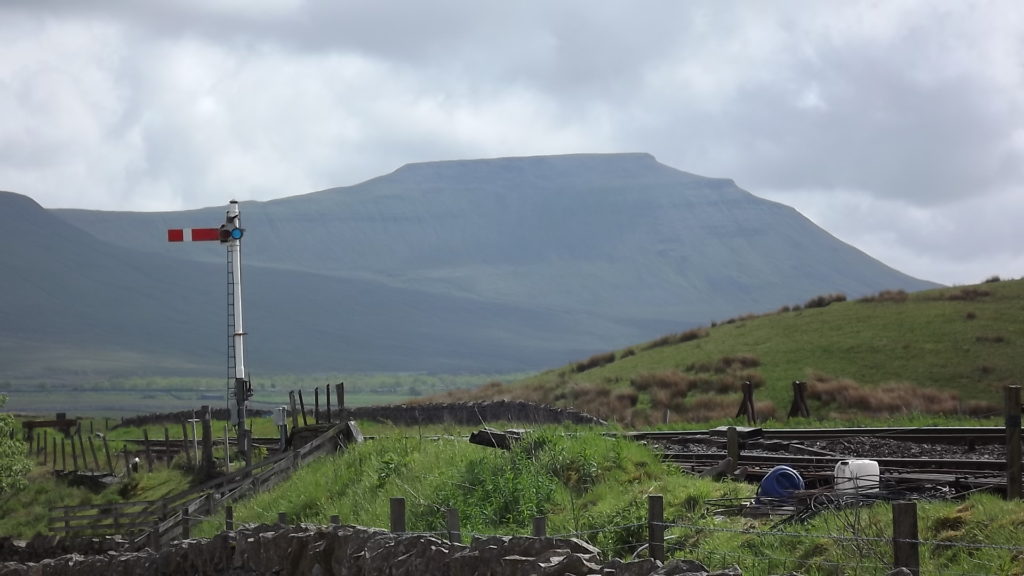
The most scenic route that Tornado is allowed to run on is surely the Settle and Carlisle line. This route incorporates some of northern England’s most dramatic scenery, including long tunnels and high viaducts, all built by muscle power and the sacrifice of an army of railway navvies, few of whom would live past their forties, killed either by accident or their unhealthy alcohol-fuelled lifestyle. 

The drama of the setting on the Settle and Carlisle is enhanced by the display of power shown by Tornado as the locomotive puffs its way up some of the steepest gradients in the country.


The boy who once watched Evening Star
Until its smoke had gone too far
Has never lost that childhood dream
And welcomes back the age of steam
A chance presents to see at last
Mighty Tornado thunder past
He joins the crowd beside the line
To wait the loco’s vanguard sign
A distant whistle tears the air
The rumbling rails tell all: “Prepare!”
Then comes the voice that none can doubt –
The shunt of steam, shout on shout
The pistons’ noise assails in waves
Tornado twists past navvies’ graves
Powering on to climb the height
Affording all a fleeting sight
Of flashing, steaming black and green
A brief, to be remembered, scene
Whistling, pounding screams and wails
Rebound from hills and down the dales
Tornado’s music blasts the ear
A memory of yesteryear


© John Welford


Tuesday, 27 March 2018

Trust Means Everything: a story


Steve knew all about trust. As a volunteer on the local lifeboat he trusted all his fellow crewmen and he knew that they trusted him. When the call came they all had to work as a team and lives were saved because they could rely on each other to put their training into practice and do exactly the right things. Lives depended on that trust – not only those of the people they rescued but their own.

That had been very apparent one day last year when a fishing trip had gone disastrously wrong for a local family. Their boat’s engine had failed and a squall had blown in from the southwest, taking the boat far too close to the rocks for comfort. The call for rescue had been responded to promptly, but as the inshore lifeboat approached the scene a particularly large wave carried the fishing boat on to the rocks and the three family members were thrown out.

Steve could see that two of the fishermen – a father and his elder son – had been thrown on to a higher level and were able to scramble to a position where they out of danger from further waves.

However, this was not the case with the younger son, aged about 12, who had landed awkwardly on a lower rock and was not moving. Not only that, but the rock in question was being washed by the sea and the next large wave could easily have taken him back into the water. This boy was clearly the first priority for the rescuers.

Steve’s task was to get on to the rocks and lift the boy to safety, but in order to do that he needed one of his colleagues to steer the inflatable lifeboat as close to the rocks as possible so that Steve could jump ashore. This required seamanship of the highest order so that nobody’s life was put at unnecessary risk.

Only teamwork could have saved the situation, and that was what was displayed on that occasion. Each member of the team trusted everyone else to do the right thing, and that was what they did.

When Steve reached the casualty he had a shock, because he recognized the boy as being Craig, a member of the Scout troop that Steve ran in the village. Of course, a lifeboatman acts in the same way whether he knows the people be rescues or not, but it must add an extra emotional tug when it is somebody that is personally known to him.

All three members of the family were taken to safety, but Craig’s injuries turned out to be serious and it eventually became clear that he might never walk again. From now on he would have to rely on a wheelchair.

However, that did not stop Craig from continuing to be a member of the Scout troop. Steve was delighted to see him turn up at the Scout hall as soon as he could after leaving hospital, and Craig continued to be a popular and valued member of the troop.

One aspect of the trust placed in lifeboatmen is that they will always respond to a “shout” as soon as it comes. When the pager sounds it is essential that they drop everything and get to the lifeboat station as soon as possible. Steve’s experience with Craig’s rescue had made that abundantly clear. Only seconds after he had been taken off the rocks another massive wave had come in that would have swept both him and Steve into the sea.

Steve was therefore never without his pager when he was on call, and the members of his Scout troop knew that. Fortunately, it had never happened that a call had come during a Scout meeting, but there was a first time for everything. If the pager went off, Steve would have to go, no questions asked.

One evening, about a year after Craig’s rescue, Steve decided to give his Scouts a demonstration of what trust involved. They would play the “fall over backwards” game that has been played many times in various contexts. One person stands immediately behind another and, at a given signal, the front person falls backwards to be caught by the back person before he or she hits the floor.

It is nothing more than an illustration of what trust means, because it would be unthinkable for the back person to stand to stand aside and break the trust. The ramifications could be quite serious! Even so, it is a game that makes the point quite well.

On this occasion, Steve had a small problem in that, although he had an even number of Scouts in the room, one of them was Craig in his wheelchair. He decided to give Craig the job of blowing the whistle while he made up the numbers by being one of the catchers.

The scouts arranged themselves in a semi-circle, divided between fallers and catchers, the idea being that they would swop over and change roles the second time round. Craig sat in the middle, armed with the whistle. Everyone waited for his signal.

Two things then happened at exactly the same time. From the far side of the room, in the pocket of Steve’s jacket hanging on a hook on the wall, came the unmistakable sound of his emergency callout pager.

The second thing was that Craig blew the whistle.

© John Welford


Time: a quad poem


(The challenge was to write a poem of four four-line stanzas, each of four four-letter words)
******************************************************************


Tick tock tick tock
Keep step don’t stop
Tock tick tock tick
Walk tall don’t trip

Must pace life fast
Zing zest dart dash
Trot trit clop clip
Tock tick tock tick

Time runs like sand
Rush past, take mind
Gone, won’t come back,
Tick tock tick tock

Tock tock tick tick
Such flux must tire
When will time stop?
Tick tick tock tock

© John Welford


The Waiter's Tale: a story


He was very good at waiting. It was something that he’d been doing all his life, in one way or another. His mother once told him that he’d kept her waiting for more than three weeks before he’d made up his mind to be born, so perhaps that had helped to set his life in its apparently inevitable course. Like Micawber, he had a definite idea that one day something worth having would turn up, and in the meantime he was prepared to wait. There seemed little point in taking hasty action to move things along.

His career choice, if it could be called that, was wholly appropriate. Here he was, in white shirt, black waistcoat and bow tie, waiting at table in a small, unfashionable restaurant that was just about staying in business. Tonight he was the only waiter on duty, which did not matter all that much, given that there were hardly any diners. 

It suited him, this un-busy lifestyle, as it gave him plenty of time to indulge his only hobby, which was the reading of great literature. He was not a particularly fast reader, but that did not bother him.  He was prepared to wait for a plot to unfold or a character to develop. Not for him the rush to the last page and the final denouement. A great book was like a fine wine or a gourmet meal, to be savoured and lingered over rather than swallowed at a gulp.

Over in the far corner, a middle-aged lady had had enough time to study the menu and was looking around for someone to take her order. He made sure that he could not be spotted easily and let her wait a little longer before he drifted over to her table.

He wrote her order down, slowly. He saw no reason for haste – he had all night, even if she didn’t. Fortunately, she seemed to be of a similar mind. She had caught the mood of this place and soon came to realise that she was probably in for a long night. This restaurant was relaxed with a capital R. There was no point in rushing things.

“What’s the book?” she asked. He had stuffed it inside his waistcoat when he had decided to stop reading and take her order, and the book was difficult to miss as he stood at her table. 

“Chaucer”, he said, “The Canterbury Tales. In the original Middle English”.

“I’m impressed”, she said. “It’s not what I would have expected a waiter to be reading”.

“I’d better get your order in”, he said.

“But come back when you’ve done so”, she called after him. “I’d like to talk”.

The lady must have been well into her 50s. He’d waited a long time to get chatted up while at work, and he could have hoped for somebody a little younger, but it was a quiet night and a little conversation would not be unwelcome. So he did what she asked.

“So what do you make of Chaucer?” she asked. “A bit heavy-going, surely? And please sit down – you’re giving me a crick in the neck”.

So they sat and talked about Chaucer, as he went back and forth between her table and the kitchen to fetch her meal. She asked him what he thought made Chaucer a great writer and what he liked and disliked about him. She asked him about his favourite tale, and about how he reckoned Chaucer might have got on had he been living today.

“And you?” she said, “What’s your tale?”

“I haven’t got one”, he said.

“Come on – everyone’s got a tale to tell. So why are you a waiter in this place when you’ve got enough brains to be reading Chaucer and to know what you’re reading? What are you – 30 or so? Why haven’t you made a better go of your life than you have?”

“I’m waiting”.

“I know. I can see that.”

“No. I mean that I’m waiting for my brother to give me what I’m owed”.

“I’m intrigued”, she said. “Tell me more”.

"My parents died in a plane crash about five years ago. They hadn’t made a new will since just after my elder brother was born, more than 35 years ago. My father often said that he would sort things out so that I would benefit as well as my brother, but he never got round to it. And I wasn’t all that bothered, because my brother said once that he’d see that I was OK in any case, so that’s how things stayed. Legally, I’m not entitled to anything, but my parents wanted me to have a share, and my brother knows that, so it’ll turn out fine in the end.”

“So how much money are we talking about?” she asked. “Ten thousand? Twenty?”

“Oh, more than that”, he said, “I reckon my father was worth about five million when he died”.

She dropped her wineglass on the table, where it deposited an appreciable quantity of house white. 

“Five million?” she almost shouted, “Think what you could do with only a fraction of that! It could change your life, set you free from this place and everything! And you’ve just been waiting five years for your brother to do the decent thing?”

“These things take time”, he said. “You have to be patient with a will of that sort of size. And there would have been death duties to pay, and things like that. So I’m grateful to him for taking all that off my hands. He’s not a bad man, and he’s going to pay me something when he’s good and ready, I’m sure”.

“Are you? I take it that he hasn’t spent any of his share of the money yet?”

“Well”, he said, “he did move into Miller’s Hall last year – you know, that big place down by the river. And he bought a Bentley about the same time. So presumably his money has come through, and mine won’t be far behind”.

“You know who you are, don’t you?” she said. “You’re Patient Griselda, from the Clerk’s Tale, always taking everything that’s thrown at you and never standing up for yourself. You know who you want to be? One of those guys from the Pardoner’s Tale, who saw the prize and went for it”.

“And ended up dead!” he replied. “They found a heap of gold and killed each other in trying to grab it all for themselves”. 

“They were fools!” she said. “Their friend had died and they went off seeking Death so that they could kill him. They sought Death and they found their own. But you are searching for Life. That money can buy you a real life, not this half-existence that you have now, getting all your living second-hand from the books you read! Get out there, go to your brother, and demand what’s rightfully yours!”

“But it’s not mine to demand”, he said. “I’m sure that if I wait a bit longer…”

“You’re not going a wait a minute more than you have to”, she said. “When do you finish here?”

“As soon as you’ve finished your meal and I’ve cleared everything up”, he said.

“Right! I’ve finished, so get clearing! You are going to go to your brother tonight and sort this out once and for all, and I’m coming with you to make sure that you do!”

So, twenty minutes later, they were in her car on their way to Miller’s Hall. As she drove there was a gleam in her eye as of someone who was determined to right an ancient wrong. If he was Patient Griselda, then she was Chaucer’s Crusader Knight, riding into battle. 

At the gates that fronted the driveway of Miller’s Hall, he spoke into the intercom device. “Hello”, he said, ”it’s me, I need to talk to you – now”.

“Well hello there, little bro!” came the reply, with laughing female voices in the background. “Long time, no hear! What on earth can be so urgent that you need to talk to me at this time of night?”  However, before the question could be answered the gates swung open. Big brother was clearly in a good mood, presumably brought on by champagne and female company.

“Right”, she said, as the car moved up the long gravel drive, “this is where we get you a life!”

The elder brother was waiting for them outside the open front door as they arrived. He had a glass in one hand, a bottle in the other, and an elegant woman pressed against each shoulder. Loud music came from within the house. The party was clearly over and the guests had gone, except for the host’s partners for the night. 

“Well look who’s here!” he said as his younger brother stepped forward. “The waiter himself!  You’re a bit late to serve the drinks, but you can clear up if you like”.

The two women laughed at the weak joke, but this only served to annoy still further the former diner from the restaurant, who now emerged from the shadows at the waiter’s side.

“So you think it’s all a big laugh, do you?” she said. “You have all this wealth and luxury and your brother has nothing but a dead-end job as a waiter. You owe him, and he’s come to collect.”

“Oh, so that’s what this is all about, is it?” he said, turning to his brother and ignoring her. “You want some of daddy’s cash, do you? Well, that’s just tough luck, little bro, because I’ve got it all, and I rather like things as they are. I don’t have to give you a penny, unless you’ve got something in writing?”

“You know he hasn’t!” she spat back at him. “But you promised to see him right, and now it’s time to keep that promise. He deserves a real life, and the only thing standing in his way is you and your selfishness!”

“Oh, I’m not standing in his way”, the brother said. “He can go wherever he wants, any time. Down my drive and out of my life will do for starters”.

“But you know what your father said”, she shouted, “you were both intended to share the money.  And the new will would have said so”.

“New will?” he said. “I know nothing about a new will. But I do know about the one that the solicitor read out. Everything was left to me, and I’m keeping it.  Goodbye”.

With that, he was about to turn and go back into the house when his younger brother suddenly sprang into action. Having said almost nothing during this conversation, he found himself experiencing something that was new and disturbing – anger. All his life he had waited. He had waited for something to turn up and for his brother to keep his promise. And now he could see that this was not going to happen. His elder brother, whom he had admired and trusted, was going back on his word and leaving him in the dirt. A real, fulfilled life had been denied him. He had spent his life reading about other people’s lives and imagining himself in their place – experiencing love, adventure, mystery and wild emotions – but second-hand life was all that he was ever going to have.

Never having been angry in his life, he did not know how to handle anger when it arrived. It now controlled him completely and he found himself screaming and shouting as he charged at his brother, his hands aiming for his neck. When they arrived they squeezed harder than he knew how, and the pressure on his brother’s windpipe did not relent until long after all life had been extinguished from the man who had cheated him of his own life.

He had come here tonight looking for Life, and Life is what he got. The judge recommended seventeen years before parole could be considered.

© John Welford