Nobody could call me a frequent flyer. The number of times I have been on board a plane in my life is precisely eleven, and the reason why this is not an even number comes from the circumstances of my first airborne foray.
In 1976 I started my first professional post as a librarian,
this being part of the Library Services team of the British Council, working at
its London HQ just off Trafalgar Square. Our job was to support the British
Council libraries spread across the world.
The following year, three of the more junior members of the
Department were told that they would each be sent on a short assignment to an
overseas library. This would not only help to solve specific problems that had
arisen but would give each of us a taste of what we could expect if we took an
overseas posting later on.
The three of us knew that the assignments were to Amsterdam,
Yaoundé (in Cameroon) and Moscow, but it was a toss-up as to who got which.
I got Moscow. The job was to extend an existing small
collection in the Cultural Section of the British Embassy, with a view to it
acting as a postal library for learners of English across the Soviet Union,
which did not have a British Council library as such. I was to make two visits
– one to survey the scene and place orders for new stock, and the second to put
everything in place and compile a catalogue once the stock had arrived.
For my first trip I was to stop over in Warsaw to visit the
British Council library there and get advice from the staff about what would be
suitable for Moscow. My first flight was therefore from London Heathrow to
Warsaw.
However, it was the second flight, from Warsaw to Moscow,
that was far more interesting!
This was a Swissair route from Zurich to Moscow via Warsaw,
so the plane was already half full when I boarded. A number of seats on one
side of the plane were occupied by a group of smartly dressed people who, I was
told by a fellow passenger, were members of an American professional tennis
team on a European tour. I wondered if I would recognize any of them but failed
to do so until one face caught my eye. The round glasses, the short hair – it
could only be Billie-Jean King! So I was sharing a flight with one of the
best-known people in women’s tennis – what an honour!
The flight itself was smooth enough, apart from having to
fly around an enormous thundercloud somewhere over Belarus, and I was
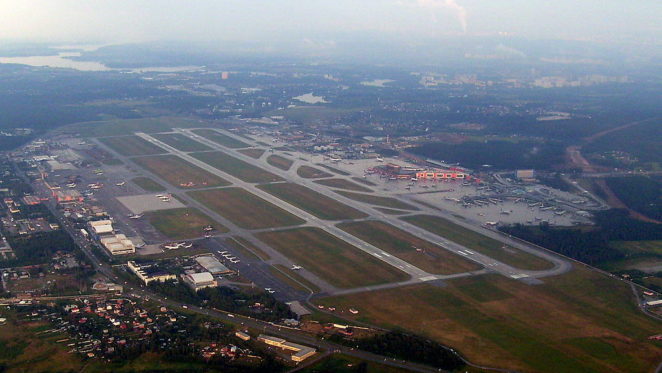
interested to see the landscape of Russia as we flew lower on our approach to Sheremetyevo
Airport. From my window seat I could see someone’s dacha in the woods, which
must have been close to the airport perimeter. I wondered how the owner felt
about the constant noise from aircraft taking off and landing.
But I did not have long to wonder, because our landing was
imminent. I could see the flaps on the wings being extended and heard the
wheels lock into place. We had to be very close to the runway.
Only - we didn’t land. We could only have been a few feet
from touchdown when the nose of the plane was tilted upwards, the flaps slid back
into place and the engines roared into life. We took off again and spent the
next few minutes circling above the airport, which incidentally gave us a
splendid aerial view of Moscow. The captain explained that he had had to abort
the landing because there was another plane already on the runway that we would
have hit had we continued. Presumably this was a little fact that Air Traffic
Control had forgotten to mention!
We landed safely enough the second time around and everyone
got ready to leave the plane. There were two exits – front and rear – and I
made for the front one. The plane disgorged its passengers out on the tarmac
and an airport bus was there to take us to the terminal. We all got on board
and found that there were only a few seats with most of the space taken by
luggage racks and standing room for passengers to straphang on the short
journey across the airport.
The bus started off and made a U-turn which took it round
the back of the aeroplane. That was when we could see the passengers who had
used the rear exit, Billie-Jean included, all standing on the steps with
nowhere to go. The bus driver seemed to be totally oblivious to the fact that
the plane had two exits and he was supposed to collect passengers from both of
them. At least, he was oblivious until somebody pointed this out to him.
He then performed another U-turn, but this was considerably
sharper than the first one. The bus nearly went on two wheels as it swung
round. Bags flew off luggage racks and straphangers, including me, were knocked
off their feet and landed in unseemly heaps on top of each other. We were still
getting ourselves sorted out when the bus stopped, the doors opened, and the
members of an American tennis team stood there staring at the chaos within.
I don’t know if Billie-Jean King remembers this incident – she has done far more
travelling in her life than I ever have, and probably has plenty of tales she
could tell – but it was an occasion that I have never forgotten. It was an
interesting introduction to the Soviet Union! What would happen next, I
wondered.
© John Welford

