Saturday, 17 March 2018

Flying to Moscow: a story


Nobody could call me a frequent flyer. The number of times I have been on board a plane in my life is precisely eleven, and the reason why this is not an even number comes from the circumstances of my first airborne foray.

In 1976 I started my first professional post as a librarian, this being part of the Library Services team of the British Council, working at its London HQ just off Trafalgar Square. Our job was to support the British Council libraries spread across the world.

The following year, three of the more junior members of the Department were told that they would each be sent on a short assignment to an overseas library. This would not only help to solve specific problems that had arisen but would give each of us a taste of what we could expect if we took an overseas posting later on.

The three of us knew that the assignments were to Amsterdam, Yaoundé (in Cameroon) and Moscow, but it was a toss-up as to who got which. 

I got Moscow. The job was to extend an existing small collection in the Cultural Section of the British Embassy, with a view to it acting as a postal library for learners of English across the Soviet Union, which did not have a British Council library as such. I was to make two visits – one to survey the scene and place orders for new stock, and the second to put everything in place and compile a catalogue once the stock had arrived.

For my first trip I was to stop over in Warsaw to visit the British Council library there and get advice from the staff about what would be suitable for Moscow. My first flight was therefore from London Heathrow to Warsaw.

However, it was the second flight, from Warsaw to Moscow, that was far more interesting!

This was a Swissair route from Zurich to Moscow via Warsaw, so the plane was already half full when I boarded. A number of seats on one side of the plane were occupied by a group of smartly dressed people who, I was told by a fellow passenger, were members of an American professional tennis team on a European tour. I wondered if I would recognize any of them but failed to do so until one face caught my eye. The round glasses, the short hair – it could only be Billie-Jean King! So I was sharing a flight with one of the best-known people in women’s tennis – what an honour!

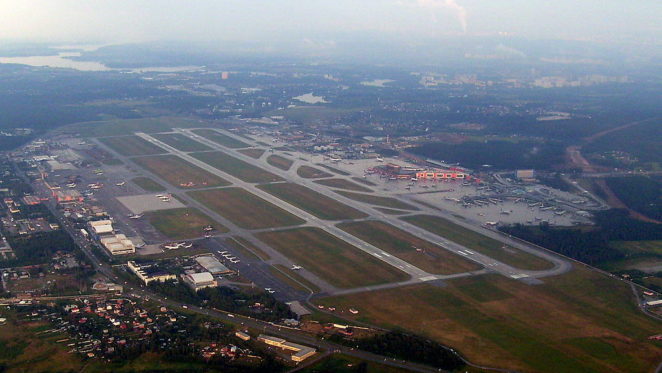
The flight itself was smooth enough, apart from having to fly around an enormous thundercloud somewhere over Belarus, and I was interested to see the landscape of Russia as we flew lower on our approach to Sheremetyevo Airport. From my window seat I could see someone’s dacha in the woods, which must have been close to the airport perimeter. I wondered how the owner felt about the constant noise from aircraft taking off and landing.

But I did not have long to wonder, because our landing was imminent. I could see the flaps on the wings being extended and heard the wheels lock into place. We had to be very close to the runway.

Only - we didn’t land. We could only have been a few feet from touchdown when the nose of the plane was tilted upwards, the flaps slid back into place and the engines roared into life. We took off again and spent the next few minutes circling above the airport, which incidentally gave us a splendid aerial view of Moscow. The captain explained that he had had to abort the landing because there was another plane already on the runway that we would have hit had we continued. Presumably this was a little fact that Air Traffic Control had forgotten to mention!

We landed safely enough the second time around and everyone got ready to leave the plane. There were two exits – front and rear – and I made for the front one. The plane disgorged its passengers out on the tarmac and an airport bus was there to take us to the terminal. We all got on board and found that there were only a few seats with most of the space taken by luggage racks and standing room for passengers to straphang on the short journey across the airport.

The bus started off and made a U-turn which took it round the back of the aeroplane. That was when we could see the passengers who had used the rear exit, Billie-Jean included,  all standing on the steps with nowhere to go. The bus driver seemed to be totally oblivious to the fact that the plane had two exits and he was supposed to collect passengers from both of them. At least, he was oblivious until somebody pointed this out to him. 

He then performed another U-turn, but this was considerably sharper than the first one. The bus nearly went on two wheels as it swung round. Bags flew off luggage racks and straphangers, including me, were knocked off their feet and landed in unseemly heaps on top of each other. We were still getting ourselves sorted out when the bus stopped, the doors opened, and the members of an American tennis team stood there staring at the chaos within.

I don’t know if Billie-Jean King remembers this incident – she has done far more travelling in her life than I ever have, and probably has plenty of tales she could tell – but it was an occasion that I have never forgotten. It was an interesting introduction to the Soviet Union! What would happen next, I wondered.

© John Welford

Fighting Back: a story


Solitude and loneliness are different beasts. One is sought, the other is avoided. But how often are they merely two sides of the same coin?
Julia longed for solitude. That had not always been her way. There had been many times in her life when she delighted in all the company she could get – men, women, old, young, it didn’t matter. She had been a social animal who could not live a day without the pleasures that other people could bring to her simply by being there.
She had always been beautiful and other people had been drawn to her presence because of that beauty. She had used her looks to make a very good living for herself as a fashion and photographic model. When other people looked at her she earned money, so the more of them that did so – either in person or by viewing photographs and videos of her – the richer she became.
But then tragedy struck. She had been in the right place but at the wrong time. It was at a house party given by one of her many friends that her life changed for ever. A young man was there who had been jilted by his girlfriend, Liz, who had also been invited. She was late arriving and her former boyfriend stood in the entrance hall of the house waiting for her, glass in hand. 
Julia was also late. She reached the open front door just a couple of feet behind Liz. The contents of the glass, when thrown, therefore splashed over the faces of both young women.
Julia spent several weeks in hospital being treated for acid burns. Despite everything the doctors did, and also despite the best plastic surgery that money could buy, Julia’s career as a model was over. 
That was why she longed for solitude. Her face had not only been her fortune, it had also been the key that unlocked the door to her whole world. She knew that the key no longer worked when her friends came to see her after she went back home. 
It was not only Julia’s face that had changed, so had that of everyone else. The face of Lydia, of Richard, of Cressida, of Becky … each one was now so different because it was no longer a face that said: “I’m your friend, your equal, let’s have fun”. Instead, the faces said: “Oh you poor thing, I do so pity you, how can I help?” Julia could not bear to listen to the words that were spoken – she did not need to, because the faces said everything.
Julia therefore shut herself away, threw away her old phone, invited nobody to visit, and did not reply to the dwindling number of invitations that came her way. She felt that this was only way she could keep her sanity. All she wanted was to be on her own.
But as the weeks went by the solitude coin flipped over and turned to what she had never wanted, namely intense loneliness. The one thing she now craved was the society of others, and she also knew that without company she would indeed lose her mind. For somebody whose pleasures depended so much on being wanted and admired, the agonies of loneliness could hardly have been worse.
She was only 25 years old, but her life was now that like of someone many years older. She had never had any interests outside her work, and now she had nothing to do other than wander round her house, watch daytime TV, eat and sleep. She was lonely and bored and wondered if this was how things would be for the rest of her life.
Then one fine morning there was a knock at her door. At first she ignored it, but it came again ... and again. Whoever it was had no intention of going away.
A voice came at her through the letterbox. “Julia ... are you there?”
“Who is it?”
“You don’t know me. My name’s Liz. I’d like to talk to you.”
Julia opened the door and looked at a face that she seemed to have seen in the mirror hundreds of times since the accident. 
Julia invited Liz in and soon realized that this was somebody whose face did not exude revulsion or pity, but recognition and comradeship.
“I’ve been trying to find you ever since what happened to us … happened”, said Liz. Everybody said that you had disappeared, but I really wanted to find you.”
“Why?” asked Julia.
“Because we’re not alone”, said Liz. “I was contacted by someone who was also an acid victim – a young Asian woman – and it turns out that there are a lot of us. I wanted to find you because I heard that you had virtually disappeared and I think you can help us.”
“I can help you?” said Julia. “How?”
“Because we’re going to fight back”, said Liz. “We want to show everyone that we’re not going to be forgotten and we have as much right to live the way we want as anyone else.”
Liz then went on to explain that the women wanted to set up an agency to promote fashion and beauty aids for acid victims and to get photographs into glossy magazines of women who refused to be beaten into silence by violent men. What they needed was someone with real expertise in that area and who knew the right people. Who better than Julia?
Who better indeed? This was just the start of a new life for Julia and Liz, and a very successful one it turned out to be.
This is just a story, but there are real Julias and Lizzes out there who are even now striking real blows for justice and sanity.

© John Welford

Friday, 16 March 2018

Deadlines: an essay


A deadline is a demand that something be done by a certain date and/or time if unfortunate consequences are to be avoided. For many people this is a horrifying prospect, but for others a deadline presents no fears and may even be the spur they need to get done what might otherwise be left undone.

Journalism is an area where deadlines rule, and nowhere is this more evident than among the fraternity of sports journalists who may, for example, have to watch an evening football match and ensure that their report of it lands on everyone’s breakfast table the following morning.
Reporters have evolved various mechanisms for making their deadlines achievable, such as writing much of the text in advance and slipping in the details later. If you only have 500 words to write, then starting your piece with: “East Cheam Athletic travelled to Mudchester United last night knowing that only a win would keep alive their hopes of avoiding relegation from the Third Division of the Scribblerian League” is a good move that says absolutely nothing about what actually happened on the night. That’s thirty words polished off at the outset with only another 470 to find.

Unfortunately, some sports reporters have taken this technique a little too far, having realized that it is quite possible to write a report without actually turning up. Just get a mate to phone you the score and name the scorers, for the price of a pint at the pub, and you can easily cobble something together in double quick time without ever leaving the comfort of your own home on a cold winter afternoon.

There was once a reporter who came badly unstuck when applying this method, on a day when the mate with the phone hadn’t actually been to the match either but still wanted his pint and phoned in an entirely fictitious score. Readers of the following day’s newspaper report wrote in to complain that the reporter must have been very unobservant not to have noticed that the match had been called off at half time due to dense fog.

We all remember having to meet homework deadlines at school. Essays had to be completed within a set number of days or grave consequences would follow. I had a friend who did extremely well at school but who always seemed to miss essay deadlines. He was consistently the last person to hand in his work, sometimes several days after everyone else had done so. He later admitted to me that this was a deliberate move on his part, especially where history essays were concerned. Having discovered the advantage of late submission he made sure to repeat the tactic every time.

The idea was to play on the psychology of one particular history teacher. Every week he would receive a batch of essays from our class of twenty or so pupils. Every week he would have to read twenty almost identical accounts of a particular piece of history, each copying bits of the textbook in slightly different configurations. His boredom threshold was not all that great, so he would skim through most of the essays, add a bit of red ink here and there to show that he had bothered, and award marks that were roughly the same in all cases.

But then he would come across the late submission from my friend, this being the answer to the question set the previous week. Suddenly the teacher would be reading something that was completely different and his interest would be re-awakened. My friend would always get a higher mark than everyone else – not because his work was noticeably better than everyone else’s, which it probably was not, but because of its novelty value.

The moral of that particular story would seem to be that if you miss the deadline you will stand out from the crowd. That is almost certainly true, but it could be a dangerous tactic if you stand out for the wrong reason.

It cannot be doubted that some people, especially in the world of the arts, thrive from having to meet deadlines and often produce their best work when under severe time pressures.

Of nobody was this more true than the opera composer Gioachino Rossini, who was blessed with the ability to be able to write at breakneck speed when so required. The story of the composition of the overture to The Thieving Magpie – if it is true, and it might not be – bears this out.

The premiere of the two-act opera was scheduled for the evening of 31st May 1817 at Milan’s famous opera house, La Scala. On the afternoon of the day in question, Rossini turned up at La Scala to be faced by a very worried theatre producer who said that the musicians had all the music they needed apart from the overture. Where was it?

Rossini replied that he hadn’t actually written an overture. Just for once, he said, what about staging an opera that launched straight into Act One? The producer thought differently. Every opera he had ever produced began with an overture, and this one would be no exception.

He therefore bundled the composer into an upstairs room, supplied him with paper, pens and ink, and gave him a strict deadline. He would sit down there and then and write an overture in time for the evening performance. Rossini did precisely that. As each sheet of music was finished it was dropped out of the window where it was caught and handed to copyists who made out the parts for the orchestra. Rossini finished the overture, the performers played from sight without rehearsal, and the opera was saved from the ignominy of being incomplete.

That particular overture is generally regarded as being one of Rossini’s finest. His genius shone through despite the extreme conditions of the deadline. Who knows if it would have been as good if written under different circumstances?
Other writers – of music or words – have a very different attitude to deadlines. One who refused to take them seriously was the much lamented Douglas Adams, the author of The Hitchhiker’s Guide to the Galaxy. I will conclude with a quote from Douglas Adams that I have always liked:

“I love deadlines. I love the whooshing noise they make as they go by.”

Douglas, I’m so sorry you’re dead – it’s a great line.


© John Welford

Wednesday, 14 March 2018

A Walk on the Beach


On Boxing Day I was walking along the beach and could not help but think about all those times in the past when I had done the same, on other beaches.
I grew up in Poole, on the south coast, and beach walks were part of my childhood, especially in winter. One of our favourite outings involved a short drive to Canford Cliffs and then a walk down the zigzag cliff path on to the beach. 
On a fine winter’s day, with a stiff breeze blowing, the sand would blow along just a few inches above the surface and sting your lower legs just enough to get the blood-flow going and make you feel truly alive. We would walk into the wind for just long enough to make us feel that we had earned the right to get blown back along to where we had started.
The view on a fine day was much clearer than it would be in summer. You could see right round the Bay, from Old Harry on one side right round past Bournemouth Pier to the low headland of Hengistbury Head, with the white cliffs of the Isle of White in the far distance. This is a view that many people reckon to be one of the best in the country, but for us it was home and we took it for granted.
The main difference between winter and summer on the beach was the absence of crowds of people in winter, although there were always other families on the winter beach, doing exactly what we were doing.
A Boxing Day walk was always noticeable for young children wearing matching stripey hats, gloves and scarves that had presumably been unwrapped the day before, as had various toys such as push-along dogs and kites that were being flown for the first time.
Everyone was in a good mood, and that seemed to apply to dogs (the real ones!) as well as people. Given their freedom, the dogs would charge across the sand, sometimes rushing a few feet into the sea before dashing out again and running across to talk to any other dogs that might be sharing the beach with them, followed by trying to introduce themselves to the owners of said dogs. Distant calls to return to their masters would be ignored at first but then complied with as they ran back at full tilt. Fulsome apologies would be offered when the two families met, but these were never necessary – the incidents were always laughed off in the friendliest way imaginable.
On days when the wind was less strong and the sea relatively calm, we would try our hand at “ducks and drakes”, always assuming that we could find enough suitably shaped pebbles. I have to admit that this was never a game at which I excelled, although my father seemed to be quite good at it and able to make a stone bounce on the sea five or six times before sinking. The beaches inside Poole Harbour, such as the one at Hamworthy Park, were a better bet for this game, given the generally flat surface and the larger number of available flat pebbles.
So that was my state of mind as I took my Boxing Day walk many years later. This place was much the same as it had been half a century before, and probably another half-century and century before that. Presumably it would be just the same in a hundred years’ time, although that cannot be guaranteed given the projections of climate scientists in terms of possible sea level rises due to global warming.
This sense of stability made me feel at peace with the world and with myself. This was a simple place – the beach sloping down to the sea – the waves breaking on the shore, just as they had done on beaches all over the world for millions of years – the seabirds wheeling in the sky above me. If the world could carry on performing such straightforward rituals as tides rising and falling and winds blowing sand along beaches, then why can’t humans live their lives along similar lines? Why do we have to make things so complicated for ourselves?
OK – that’s a naïve thing to say, and there are all sorts of reasons why human life in the 21st century is far from simple. But it was a comforting thought while it lasted!
© John Welford


Sunday, 7 January 2018

A Journey to the Past


He had had the piece of paper for years. He now held it in his hand and read it yet again. It was a copy of a birth certificate for someone called Derek Alexander Clayton:
Born on 11th August 1952 at 11.55pm. Only five minutes from being the 12th of August then!
Mother’s name: Elizabeth Greenaway Hunter Rule or Clayton – wife of William Cecil Clayton, Sgt RAOC, to whom she was married 30th January 1947 at Falkirk.
The birth had been registered on 2nd September 1952, but alongside this date was a note: Adopted (England).
The place of birth was given as 136 Merchiston Avenue, Falkirk. Thanks to the wonders of modern technology he had visited the address several times before, via Google Maps, but today was different.
Today he was in Merchiston Avenue, standing across the street from number 136 and looking at the house in which he had been born more than 65 years before.
He could easily believe that not much had changed in Merchiston Avenue since that day in 1952. The properties consisted of semi-detached pebble-dashed blocks, with each semi comprising two flats, upstairs and downstairs, each with its own entrance door at the side of the building. The block in question had the numbers 140 and 138 on the left-hand side and 136 and 134 on the right-hand side, so he assumed that 136 would be the upper floor flat.
The street had every appearance of being part of a post-war council estate, and it looked to him as though a good proportion of the properties were still council owned, given the relatively small number that had had their appearance improved by former tenants who were now private owners.
Now that he had made the long journey north from his home in Leicestershire, he felt that he had accomplished something, although he was not quite sure what that was. This somewhat drab street in a Scottish town, with the noise of traffic from the nearby A9 forming a constant background hum, was where he had started his life, and knowing that was at least something. After all, he knew almost nothing else about his origins, other than what was printed on that piece of paper.
All he wanted to do now was take a photograph of the house and make his way back home again.
However, he had hardly had time to point his camera at the upper flat before he was aware that someone was trying to attract his attention by knocking at the window from inside.
A few seconds later a woman, a few years younger than himself, had opened her door and was now walking across to where he was.
“Hey you”, she said, “What’s your game? Why are you taking pictures of the flat? Are you from the Council?”
He put the camera down. “No”, he said, “I didn’t mean to cause any offence. I just wanted to take a shot of the house I was born in.”
The woman’s manner suddenly changed. It looked for a second as though she was the one who had been shot, and with something more lethal than a camera.
“What did you say?” she asked. “You were born here?”
“That’s right”, he said, and he showed the woman his birth certificate.
"You’d better come inside”, she said, and ushered him up the stairs of the flat that was 136 Merchiston Avenue.
“What shall I call you?” she asked.
“John”, he said.
“And how long have you known that you started life as Derek Clayton?”
“About thirty-five years”, he said. 
“And why have you only come to see us now?”
“That wasn’t my intention”, he said. “I only wanted to see the house. And what do you mean by ‘us’?”
“My name is Mary Frazer”, she said. “If I’ve got it right, I’m your sister. There’s somebody here you might like to meet. But be warned, she’s not as she once was.”
So saying, Mary ushered him into a room, in the corner of which sat a very old lady in a high-backed armchair. She did not look up as the two of them approached but continued to stare at a television that was showing a children’s cartoon show, but with the sound turned off.
She turned her head as Mary spoke to her.
“Mum”, Mary said, “There’s someone here to see you. His name is John, but he used to be called Derek.”
“Derek?” said the old woman, as though she was trying to recall a name from a long time ago. “Do I know anyone called Derek?”
“You did once”, said Mary. “You used to tell me about the baby you once lost, whose name was Derek. You used to cry yourself to sleep when I was a young girl, and I sometimes heard you in the night saying how much you missed your Derek.”
There was a sudden look of recognition on the old woman’s face.
“You’re right”, she said. “I remember now. My Derek was taken away and I never saw him again.”
“Well”, said Mary, “He’s here now. This is Derek”.
The old woman slowly moved her head to change her focus from Mary’s face to John’s. She stared at him for a few moments, then said, “Are you my Derek? You’ve grown a lot. How are you getting on at school?”
“He’s not at school, Mum,” Mary told her. “He left school at a long time ago.”
“I hope he was a good boy at school,” the old woman said, before turning back to look at him. “Do you play lots of games at school?”
Mary, with tears in her eyes, pulled John away and invited him to take a seat on the other side of the room. The old woman went back to staring at the cartoons on the television.
“If only you could have come here before”, Mary said. “She was such a lovely person to know in the old days. You would have made her so happy if she could have met you only as much as ten years ago, before the dementia got so bad.”
“Then I can only apologise”, John said. “I was always afraid that I would cause distress by turning up out of the blue, and maybe rekindle old hurts”.
“I’ll tell you the full story”, Mary said, “then you’ll understand things better. Mum and Bill Clayton did not have an easy marriage. To be frank, they had fallen out of love some time before you arrived on the scene. Bill had an eye for other women and he’d probably been unfaithful to Mum several times.
“Mum knew what he was like and she was no angel either. She didn’t see why she shouldn’t have other men in her life if he could have other women, but she also knew the value of having a husband who could provide a roof over her head. When she got pregnant she thought that that was just what she needed – she reckoned that Bill might change his ways if he had a family to care for. But she was wrong there.
“One night they had a terrible row, and Mum let slip that the baby wasn’t Bill’s. She just knew it, because Bill had been away with the Army at the time the baby must have been conceived.
“Bill was furious. He told Mum that she had a choice, because he was damned if he was going to bring up another man’s child. Either the baby went, or she did.
“Mum felt trapped. The prospect of being thrown out of her home, with a baby to look after, was one that she couldn’t face, so she agreed to have the kid adopted.
“But that wasn’t the end of it. Bill was such a hypocrite. He reckoned that she had ruined the marriage by getting pregnant by another man, and he wanted out. So he left home, found himself another woman, and started divorce proceedings. Mum was now on her own, having lost both her husband and her child.
“But along came Jimmy Frazer, who had been her friend for a number of years. He had known Bill Clayton from years before – they had been Army colleagues - and he knew what sort of man he was like. He was always there when Mum needed a shoulder to cry on, and it shouldn’t surprise you to learn that he was not only Mum’s true friend but also your father. Mum invited Jimmy to live with her in this flat, so he did. After the divorce from Bill, Jimmy and Mum got married and I am their daughter.
“That’s a sad story”, John said, “although it seems to have a happy ending. However, things don’t seem to have worked out so well for you, having to look after your Mum when she is in such a bad way.”
“Oh, it’s not that bad”, said Mary. “I have two other sisters and we take it in turns to give Dad our support.”
“So Jimmy’s still alive?”
“Oh yes – he’s over 90 but he’s still in quite good shape. In fact, I can hear him coming up the stairs now. He’s just been down to the shop to get a few things.”
As she spoke, the door opened and a tall elderly man entered the room. Although he was stooped over by the years there was still the trace of a military bearing about him. He was a little startled to see that Mary had company, but he then fixed his bright blue eyes on the stranger who was now standing up to be introduced to him.
Before Mary could speak Jimmy Frazer said just two words:
“Hello, son”.

© John Welford


Monday, 4 December 2017

The True Story of the Gunpowder Plot (maybe!)


Guy was quite enjoying his new job as a courier driver in London. He had only been doing the job for a week, but he found it quite exciting trundling his horse and cart around parts of London that were new to him, having only arrived from the country a month or so before. He had met lots of new people and had already earned several groats in tips from satisfied customers.
On the 5th of November he got a message that he was to go to Eddie Towbar’s distribution depot in east London. He was told that he only needed to bring his horse because the wagon was already loaded and ready to go. 
He was greeted by the depot foreman when he arrived.
“Name?”
“Spoons. Guy Spoons.”
“OK, Spoons, your job is to deliver a wagonload of beer to the King’s Arms in Westminster. There are two carts out in the yard, both loaded with barrels, eleven of them on each. One cart is red and the other one is green. You want to hitch your horse to the red cart. Whatever you do, don’t take the green cart.”
The foreman’s assistant laughed out loud at this.
“Oh no”, he said, “you wouldn’t want to take the green cart. That would be a huge mistake.”
“It certainly would”, said the foreman. “An enormous mistake”. The two men carried on laughing as Guy made his way out to where the two carts were waiting.
“The red cart”, said Guy to himself, “not the green cart. Definitely not the green cart”.
So Guy hitched up the cart and set off through the streets of London. 
When Guy reached the King’s Arms he had to ask for directions as to where he would find the entrance to the cellars, which he presumed were somewhere round the back. The landlord explained that it was a bit complicated, because several roads had been cordoned off on account of the huge procession that was expected very soon. 
“It’s the state opening of Parliament”, said the landlord. “King James will be arriving, as will all the Members of Parliament, and security is understandably tight. Mind you, there’ll be lots of celebrating afterwards, which is why I’ve ordered all this extra beer.”
“So where do I go?” asked Guy.
“Take the first left, then the second right, then the second left. The cellar hatch is painted green – you can’t miss it.”
“Green, you say?”
“Oh yes, definitely green. Don’t go delivering my beer down anyone else’s hatch, painted any other colour, or my party definitely won’t go with a bang tonight!”
“How do you want me to stack your barrels?” asked Guy.
“There are several bays in the cellar”, said the landlord, “just go to the one at the far end and stack them up there.”
“No problem” said Guy.
Guy was about to set off with his cart when the landlord spoke to him again.
“Oh, just one thing,” he said. “Because of the royal procession there’s every chance that the roads will be completely blocked by the time you finish. I suggest that you stay down there with the barrels until the coast is clear. I’ll send one of my barmaids down with some food and plenty of candles, and I’ll make sure that you get a decent tip at the end of it all. You can rest assured that you’ll get much more than you were expecting.”
“First left, second right, second left, green hatch?”
“That’s right. There some red hatches in the neighbourhood, but only one green one. You wouldn’t want to deliver my beer down a red hatch!”
So off Guy trundled off with his cart and made his way along the route he had been told. 
“Left, right, left” he said to himself. “Now where’s the green hatch? Ah. There it is.”
He did wonder a bit why the cellar entrance appeared to be out of sight of the King’s Arms, but when he opened the hatch and looked inside he could see that a tunnel ran away into the distance, so it could easily, he thought, run underneath the pub.
Getting the barrels down the ramp into the cellar was easy enough, as was rolling them down the tunnel, which was lit with lanterns all the way along. It took some time, but eventually Guy was able to stack the eleventh and last barrel in the bay that was furthest from the entrance hatch.
There was plenty of noise coming from above his head – lots of shouting and sounds of many feet marching up and down. Maybe they were getting ready for the big party, which had to mean that somebody would be coming for the beer before too long. All he had to do was sit still and wait – at least the barmaid with the food should turn up soon.
After a short time there was a loud noise from the other end of the tunnel. There were bright lights and men tramping along the passageway. A troop of soldiers, armed with muskets, walked into the bay where Guy was sitting.
“Stand up”, a loud voice commanded. “You are under arrest for being right underneath the House of Lords surrounded by what look suspiciously like barrels of gunpowder. Put your hands where I can see them!”
Guy did exactly as he was told. It seemed to be the best plan, given that a dozen muskets were pointing at his face.
“What’s your name?” barked the sergeant in charge of the troop. Guy should probably have been completely open at this point, but for some reason he thought that subterfuge might be his best plan. 
“Forks”, he said, this being the only name he could think of that wasn’t Spoons. “Guy Forks”.
“How do you spell that?” asked the corporal who was taking notes of the proceedings.
“How the hell should I know?”, said Guy. “I never went to school. Write it how it sounds.”
So that is what the corporal did. And that is how the legend of Guy Fawkes was born. It was all down to the fact that the man who was supposed to deliver a load of beer for a celebration night at the King’s Arms suffered from red/green colour blindness and had a problem telling left from right. He simply delivered the wrong barrels to the wrong place - nothing more than that.
You see, there never was an actual Gunpowder Plot. All those stories about plotters being hanged, drawn and quartered were put about by the propaganda machine of the time to cover up the huge embarrassment of what really happened.
I refer, of course, to the terrible mistake made by the Royal Horse Artillery when they tried to fire a 21-gun salute for the King having primed each cannon with half a barrel of best bitter.

© John Welford


The Pockets of Power


Everything you came to love 
So freely bought and sold
An easy life, dependent on
A pocketful of gold

A world of privilege and greed
Was yours from earliest youth
You never knew the contents of
A pocketful of truth

You opened wide your gaping maw
From which came – no surprise –
The latest mad extraction from
Your pocketful of lies


You sought to foment seismic change 
And make your country great
But deeply thrust your hand inside
A pocketful of hate

What you dislike’s condemned as fake 
You guess this makes you strong
But only adds more substance to
Your pocketful of wrong


Your moral baseness further dips
With each offensive tweet
And yet more shame augments what’s in
Your pocket of deceit

All decent folk desire that you
Will not achieve your goals
Each decanted safely in
A pocketful of holes


© John Welford