Monday, 19 March 2018

Juliet: Hatched, Matched, Despatched


This is Radio Capulet, broadcasting to all parts of Verona with the sole aim of telling everyone that the Capulets are top dogs round here and a Capulet is worth a hundred Montagues.
The main purpose of today’s bulletin is to tell everyone the wonderful news that Lady Capulet was safely delivered last night of a daughter, whom we shall name Juliet. Mother and baby both look to be in excellent health.
God willing, Juliet will avoid all the perils of childhood and live a full active life. In the fullness of time she will make a good marriage and be the mother of sons who will defend the Capulets and oppose the dastardly Montagues. 
Today is a great day for the Capulets and therefore for all Verona. As for what the Montagues might think, who cares?

************************************************************

This is Radio Capulet, with great news for Verona and a body blow for the Montagues. We are proud to announce that Juliet, the daughter of Lord and Lady Capulet, second only in greatness to Prince Escalus, has today been sought in marriage by Count Paris, who is not only a man of great wealth and high character but also a kinsman of the Prince.
This match will bring great credit on the Capulet family and show those Montagues just how inferior they are. Count Paris could have chosen any fair maiden of Verona for his bride, even a Montague if he had wished - if any Montague maiden could be described as “fair”, but no – only a Capulet was good enough him and we salute his excellent judgement.
Just a moment, listeners. I’m getting some other information in my headphones. What’s that? She’s done what? I don’t believe it – it’s not possible.
I’m sorry, listeners. I’ve just been told that Juliet has refused to marry Paris, and there’s a rumour that she’s been seen running off to Friar Lawrence’s cell, with the intention of marrying someone else. Who could that be?
What? No way! That can’t be true! She’s a Capulet – she just wouldn’t do such a terrible thing, would she?
This broadcast is suspended until the situation is sorted out and we have some better news to bring you. Thank you for listening.

*****************************************

This is Radio Capulet, with even worse news to bring you. Juliet is dead – killed by her own hand.
It’s a terrible story. It seems that she was deeply in love with Romeo Montague, and the feud between the families has led to the deaths of both Juliet and Romeo. Because we wouldn’t listen to her, and insisted that she marry Count Paris, she was forced to adopt a subterfuge in which she played dead, in the hope that Romeo would be able to find her and take her away before she woke up. However, the plan went wrong and Romeo believed that she really was dead, after which he took poison and died. When Juliet came round and found him dead she stabbed herself with his dagger.
So the lovers both died because their love was so great that they couldn’t live without each other.
Or, to look at it another way, their love was greater than the insane pride of our two families. We killed our beautiful Juliet because we saw her as an object for own advancement and not as a real person with her own feelings, wants and needs.
The Capulet family hereby announces that the feud with the Montagues is over, and that never again will we be so stupid as to allow our pride to kill our children.
Let this be a lesson to everyone listening to this broadcast. You’ll never do anything like this, will you? Let’s hope that never again will anyone ignore the power of love and let hatred rule their hearts. That doesn’t sound too much to ask, does it?
© John Welford


Hunting the cobra-preta: a story


The mountainous island of São Tomé lies in the Gulf of Guinea off the west coast of Africa, almost bang on the Equator. Near the centre of the island, which is about 30 miles long and 20 miles wide, is a dormant volcano that is covered in dense forest. Nobody knows when the volcano last erupted and nobody is expecting any action of that kind in the foreseeable future.
Of far more interest is the island’s wildlife, and in particular the cobra-preta. This is a black snake – which is exactly how the name translates from Portuguese – that is believed to be the most venomous snake in Africa. The locals on São Tomé say “homem mordido, homem perdido”, which means “man bitten, man lost”.
It is known that the snake lives in the forests of São Tomé, but the question is – how did it get there? Is it simply a local variant of the forest cobra of West Africa? One theory is that the early Portuguese colonists introduced it to the island to get rid of the rats that the settlers had inadvertently brought with them. However, it seems strange that anyone would want to live on an island to which they had deliberately brought Africa’s most dangerous snake. 
That was why the experts preferred to take the line that the cobra-preta was a species native to São Tomé. The island does not have many species that are identical with those on the mainland, given the difficulty that animals would have faced in crossing nearly 200 miles of ocean, and the fact that humans did not apparently reach it prior to the Portuguese in the 15th century. São Tomé has several species that are found nowhere else in the world, having evolved in far distant times, so why should the cobra-preta not be one of these?
It was the realization that the cobra-preta was not an introduced species but a native one that saved it. Moves had been underway to eradicate the snake, which clearly presented a danger to the local population, but were it to be lost it would be yet another casualty on the list of species rendered extinct by human hand.
But if the cobra-preta was to be preserved it had to be studied, with specimens captured not least so that its DNA could be examined and its true place on the evolutionary tree determined. This is in addition to the many other reasons why naturalists would want to take a close look at what is essentially a “new” species.
That was why a scientific team assembled at the foot of São Tomé’s former volcano one day a few years ago. The upper mountain slopes were known to be home to the cobra-preta, but it had also been seen lower down. The team members would need to be alert every step of the way.
The party consisted of six people - three scientists and three assistants, including a local guide. On the night before, the guide had told the party all the stories he knew about the cobra-preta, including the charming legend, dating from 1506, that when a man was bitten by the snake the effect was so sudden and so terrible that his eyes would explode out of his head as he died. They all laughed nervously at that one!
Jake was the assistant on the expedition who was responsible for making sure that all the kit they needed was in place and worked as it should. This included not only the cage in which they would place their specimen, and the tools for grabbing it behind the head and securing it before it could get a chance to strike at anyone, but also the heavy-duty trousers, jackets and gloves that they would need to wear in order to prevent any chance of a bite, as well as providing protection against soldier ants and other creepy-crawlies. Given the hot, steamy conditions of the equatorial forest, this sort of clothing was not particularly comfortable to wear, but they all knew that it was essential. One thing that Jake could not provide was anti-serum to counter the bite of the cobra-preta, given that such a thing did not exist.
There had been heavy rain for several days prior to the expedition, and they set off up the steep, zig-zagging mountain track in what they hoped would be a long enough interval of relative dryness. That turned out to be a forlorn hope, because two hours after they set out the rain came back in torrents.
The path, which was wet enough to start with, was soon several inches deep in mud, making every step a struggle. It was even worse for Jake, loaded down with his bulky kit, who found that his footsteps made such large holes in the mud that it was a real effort to get his feet out again. He was soon at the back of the party, with the others able to make slightly faster progress.
As the rain poured down the slope it began to run across their zigzag path, with walls of water cascading on top of them from the side as they walked. But then things got even worse because the water turned to mud and it carried tree branches and rocks with it. The upper slope of the mountain simply gave way and a full-scale mudslide crashed down on top of them.
Everyone in front of Jake stood no chance and was simply buried in the mud and carried off down the slope. Jake was lucky in that he was only caught by the edge of the mudslide, knocked off his feet and taken a short way down the mountain. He tried to stand, but before he could do so a torn-off tree branch landed on him and pinned him to the ground. He was knocked unconscious and lay still as the bulk of the mudslide passed close by, taking all his companions with it.
When Jake came round he found himself lying on a patch of level ground with undergrowth on one side that had escaped the mudslide. The rainstorm was over and the mud had stopped sliding. He called out but there was no reply apart from the cries of jungle birds. 
He soon saw that his right arm and foot were trapped under the branch that fallen on top of him. There was a way of freeing his arm, but only if he could get out of his protective jacket, which had been partly torn open anyway. Once this was achieved he could tackle his foot, and the easiest way of doing this was to ease the foot out of itsboot, the toe of which was firmly wedged under the branch. This took some time but was eventually done, with his thick sock staying inside the boot.
So now he was able to stand, with one foot booted and the other bare, and take stock of his surroundings. He caught a movement in the bush to the side of the open space. He took another look. Something black was moving through the undergrowth. It emerged, and a thin black face looked him straight in the eye. A forked tongue flicked out in his direction.
There could be no doubt about it. He had found a cobra-preta. But instead of being equipped with a grabbing pole and a cage he had nothing with which to protect himself. He had jettisoned his protective jacket and had one bare foot.
He took an involuntary step backwards. His unbooted foot touched something on the ground that was soft to the touch. He looked down, and a human eye looked straight back at him.

© John Welford


Sunday, 18 March 2018

How to break an umbrella


I once, when I lived in London, had a friend who spared no expense when it came to buying umbrellas. Not for him the cheap foldaway versions that you can slip into a briefcase and which can be bought for very little from just about anywhere. No – his umbrellas were of the best quality, long, slender and with perfectly moulded wooden handles. An umbrella, for him, was something to be seen with, not just to keep the rain off. Indeed, he always carried a brolly whether it was likely to rain or not.

I was with him once when we were negotiating our way through the London Underground. It was not the height of the rush hour, so the trains were not all that frequent. If you had just missed a train it could be 20 minutes or more before the next one that was going to where you wanted.
We reached the platform just as a train was about to leave. We knew it was there and so we ran down the escalator and along a short passage on to the platform. The carriage doors were starting to close – we were obviously just too late and had no chance of catching it. There was no choice but to wait for the next one.
However, my friend had other ideas. He knew, as did I, that if you can prevent the train doors from closing they will open again and let you get on board. Grabbing a door, or sticking a foot into the gap, will usually do the trick. However, we were not close enough to do this, so my friend did what he thought was a stroke of genius – he lunged forward with his umbrella and managed to get it wedged between the closing doors. 
Naturally, he expected the doors to re-open, but on this occasion he was wrong. The beautifully pointed end of his expensive umbrella was just too slender to register as an obstruction that would force the doors apart and they stayed firmly shut, with the umbrella just as firmly trapped between them.
The train then started off up the platform, with my friend desperately trying to tug his umbrella away from the doors. Of course, the train was soon going faster than he could run and he was forced to let go.
The final indignity came when the train door in question disappeared into the tunnel at the end of the platform and the protruding umbrella was smashed to pieces against the tunnel wall. 
It was an expensive lesson to learn!


© John Welford


Saturday, 17 March 2018

Flying to Moscow: a story


Nobody could call me a frequent flyer. The number of times I have been on board a plane in my life is precisely eleven, and the reason why this is not an even number comes from the circumstances of my first airborne foray.

In 1976 I started my first professional post as a librarian, this being part of the Library Services team of the British Council, working at its London HQ just off Trafalgar Square. Our job was to support the British Council libraries spread across the world.

The following year, three of the more junior members of the Department were told that they would each be sent on a short assignment to an overseas library. This would not only help to solve specific problems that had arisen but would give each of us a taste of what we could expect if we took an overseas posting later on.

The three of us knew that the assignments were to Amsterdam, Yaoundé (in Cameroon) and Moscow, but it was a toss-up as to who got which. 

I got Moscow. The job was to extend an existing small collection in the Cultural Section of the British Embassy, with a view to it acting as a postal library for learners of English across the Soviet Union, which did not have a British Council library as such. I was to make two visits – one to survey the scene and place orders for new stock, and the second to put everything in place and compile a catalogue once the stock had arrived.

For my first trip I was to stop over in Warsaw to visit the British Council library there and get advice from the staff about what would be suitable for Moscow. My first flight was therefore from London Heathrow to Warsaw.

However, it was the second flight, from Warsaw to Moscow, that was far more interesting!

This was a Swissair route from Zurich to Moscow via Warsaw, so the plane was already half full when I boarded. A number of seats on one side of the plane were occupied by a group of smartly dressed people who, I was told by a fellow passenger, were members of an American professional tennis team on a European tour. I wondered if I would recognize any of them but failed to do so until one face caught my eye. The round glasses, the short hair – it could only be Billie-Jean King! So I was sharing a flight with one of the best-known people in women’s tennis – what an honour!

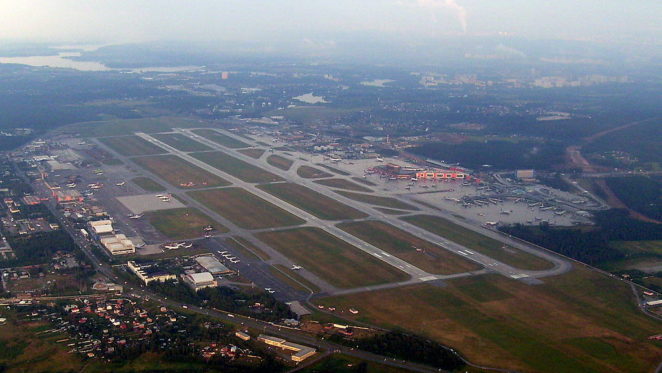
The flight itself was smooth enough, apart from having to fly around an enormous thundercloud somewhere over Belarus, and I was interested to see the landscape of Russia as we flew lower on our approach to Sheremetyevo Airport. From my window seat I could see someone’s dacha in the woods, which must have been close to the airport perimeter. I wondered how the owner felt about the constant noise from aircraft taking off and landing.

But I did not have long to wonder, because our landing was imminent. I could see the flaps on the wings being extended and heard the wheels lock into place. We had to be very close to the runway.

Only - we didn’t land. We could only have been a few feet from touchdown when the nose of the plane was tilted upwards, the flaps slid back into place and the engines roared into life. We took off again and spent the next few minutes circling above the airport, which incidentally gave us a splendid aerial view of Moscow. The captain explained that he had had to abort the landing because there was another plane already on the runway that we would have hit had we continued. Presumably this was a little fact that Air Traffic Control had forgotten to mention!

We landed safely enough the second time around and everyone got ready to leave the plane. There were two exits – front and rear – and I made for the front one. The plane disgorged its passengers out on the tarmac and an airport bus was there to take us to the terminal. We all got on board and found that there were only a few seats with most of the space taken by luggage racks and standing room for passengers to straphang on the short journey across the airport.

The bus started off and made a U-turn which took it round the back of the aeroplane. That was when we could see the passengers who had used the rear exit, Billie-Jean included,  all standing on the steps with nowhere to go. The bus driver seemed to be totally oblivious to the fact that the plane had two exits and he was supposed to collect passengers from both of them. At least, he was oblivious until somebody pointed this out to him. 

He then performed another U-turn, but this was considerably sharper than the first one. The bus nearly went on two wheels as it swung round. Bags flew off luggage racks and straphangers, including me, were knocked off their feet and landed in unseemly heaps on top of each other. We were still getting ourselves sorted out when the bus stopped, the doors opened, and the members of an American tennis team stood there staring at the chaos within.

I don’t know if Billie-Jean King remembers this incident – she has done far more travelling in her life than I ever have, and probably has plenty of tales she could tell – but it was an occasion that I have never forgotten. It was an interesting introduction to the Soviet Union! What would happen next, I wondered.

© John Welford

Fighting Back: a story


Solitude and loneliness are different beasts. One is sought, the other is avoided. But how often are they merely two sides of the same coin?
Julia longed for solitude. That had not always been her way. There had been many times in her life when she delighted in all the company she could get – men, women, old, young, it didn’t matter. She had been a social animal who could not live a day without the pleasures that other people could bring to her simply by being there.
She had always been beautiful and other people had been drawn to her presence because of that beauty. She had used her looks to make a very good living for herself as a fashion and photographic model. When other people looked at her she earned money, so the more of them that did so – either in person or by viewing photographs and videos of her – the richer she became.
But then tragedy struck. She had been in the right place but at the wrong time. It was at a house party given by one of her many friends that her life changed for ever. A young man was there who had been jilted by his girlfriend, Liz, who had also been invited. She was late arriving and her former boyfriend stood in the entrance hall of the house waiting for her, glass in hand. 
Julia was also late. She reached the open front door just a couple of feet behind Liz. The contents of the glass, when thrown, therefore splashed over the faces of both young women.
Julia spent several weeks in hospital being treated for acid burns. Despite everything the doctors did, and also despite the best plastic surgery that money could buy, Julia’s career as a model was over. 
That was why she longed for solitude. Her face had not only been her fortune, it had also been the key that unlocked the door to her whole world. She knew that the key no longer worked when her friends came to see her after she went back home. 
It was not only Julia’s face that had changed, so had that of everyone else. The face of Lydia, of Richard, of Cressida, of Becky … each one was now so different because it was no longer a face that said: “I’m your friend, your equal, let’s have fun”. Instead, the faces said: “Oh you poor thing, I do so pity you, how can I help?” Julia could not bear to listen to the words that were spoken – she did not need to, because the faces said everything.
Julia therefore shut herself away, threw away her old phone, invited nobody to visit, and did not reply to the dwindling number of invitations that came her way. She felt that this was only way she could keep her sanity. All she wanted was to be on her own.
But as the weeks went by the solitude coin flipped over and turned to what she had never wanted, namely intense loneliness. The one thing she now craved was the society of others, and she also knew that without company she would indeed lose her mind. For somebody whose pleasures depended so much on being wanted and admired, the agonies of loneliness could hardly have been worse.
She was only 25 years old, but her life was now that like of someone many years older. She had never had any interests outside her work, and now she had nothing to do other than wander round her house, watch daytime TV, eat and sleep. She was lonely and bored and wondered if this was how things would be for the rest of her life.
Then one fine morning there was a knock at her door. At first she ignored it, but it came again ... and again. Whoever it was had no intention of going away.
A voice came at her through the letterbox. “Julia ... are you there?”
“Who is it?”
“You don’t know me. My name’s Liz. I’d like to talk to you.”
Julia opened the door and looked at a face that she seemed to have seen in the mirror hundreds of times since the accident. 
Julia invited Liz in and soon realized that this was somebody whose face did not exude revulsion or pity, but recognition and comradeship.
“I’ve been trying to find you ever since what happened to us … happened”, said Liz. Everybody said that you had disappeared, but I really wanted to find you.”
“Why?” asked Julia.
“Because we’re not alone”, said Liz. “I was contacted by someone who was also an acid victim – a young Asian woman – and it turns out that there are a lot of us. I wanted to find you because I heard that you had virtually disappeared and I think you can help us.”
“I can help you?” said Julia. “How?”
“Because we’re going to fight back”, said Liz. “We want to show everyone that we’re not going to be forgotten and we have as much right to live the way we want as anyone else.”
Liz then went on to explain that the women wanted to set up an agency to promote fashion and beauty aids for acid victims and to get photographs into glossy magazines of women who refused to be beaten into silence by violent men. What they needed was someone with real expertise in that area and who knew the right people. Who better than Julia?
Who better indeed? This was just the start of a new life for Julia and Liz, and a very successful one it turned out to be.
This is just a story, but there are real Julias and Lizzes out there who are even now striking real blows for justice and sanity.

© John Welford

Friday, 16 March 2018

Deadlines: an essay


A deadline is a demand that something be done by a certain date and/or time if unfortunate consequences are to be avoided. For many people this is a horrifying prospect, but for others a deadline presents no fears and may even be the spur they need to get done what might otherwise be left undone.

Journalism is an area where deadlines rule, and nowhere is this more evident than among the fraternity of sports journalists who may, for example, have to watch an evening football match and ensure that their report of it lands on everyone’s breakfast table the following morning.
Reporters have evolved various mechanisms for making their deadlines achievable, such as writing much of the text in advance and slipping in the details later. If you only have 500 words to write, then starting your piece with: “East Cheam Athletic travelled to Mudchester United last night knowing that only a win would keep alive their hopes of avoiding relegation from the Third Division of the Scribblerian League” is a good move that says absolutely nothing about what actually happened on the night. That’s thirty words polished off at the outset with only another 470 to find.

Unfortunately, some sports reporters have taken this technique a little too far, having realized that it is quite possible to write a report without actually turning up. Just get a mate to phone you the score and name the scorers, for the price of a pint at the pub, and you can easily cobble something together in double quick time without ever leaving the comfort of your own home on a cold winter afternoon.

There was once a reporter who came badly unstuck when applying this method, on a day when the mate with the phone hadn’t actually been to the match either but still wanted his pint and phoned in an entirely fictitious score. Readers of the following day’s newspaper report wrote in to complain that the reporter must have been very unobservant not to have noticed that the match had been called off at half time due to dense fog.

We all remember having to meet homework deadlines at school. Essays had to be completed within a set number of days or grave consequences would follow. I had a friend who did extremely well at school but who always seemed to miss essay deadlines. He was consistently the last person to hand in his work, sometimes several days after everyone else had done so. He later admitted to me that this was a deliberate move on his part, especially where history essays were concerned. Having discovered the advantage of late submission he made sure to repeat the tactic every time.

The idea was to play on the psychology of one particular history teacher. Every week he would receive a batch of essays from our class of twenty or so pupils. Every week he would have to read twenty almost identical accounts of a particular piece of history, each copying bits of the textbook in slightly different configurations. His boredom threshold was not all that great, so he would skim through most of the essays, add a bit of red ink here and there to show that he had bothered, and award marks that were roughly the same in all cases.

But then he would come across the late submission from my friend, this being the answer to the question set the previous week. Suddenly the teacher would be reading something that was completely different and his interest would be re-awakened. My friend would always get a higher mark than everyone else – not because his work was noticeably better than everyone else’s, which it probably was not, but because of its novelty value.

The moral of that particular story would seem to be that if you miss the deadline you will stand out from the crowd. That is almost certainly true, but it could be a dangerous tactic if you stand out for the wrong reason.

It cannot be doubted that some people, especially in the world of the arts, thrive from having to meet deadlines and often produce their best work when under severe time pressures.

Of nobody was this more true than the opera composer Gioachino Rossini, who was blessed with the ability to be able to write at breakneck speed when so required. The story of the composition of the overture to The Thieving Magpie – if it is true, and it might not be – bears this out.

The premiere of the two-act opera was scheduled for the evening of 31st May 1817 at Milan’s famous opera house, La Scala. On the afternoon of the day in question, Rossini turned up at La Scala to be faced by a very worried theatre producer who said that the musicians had all the music they needed apart from the overture. Where was it?

Rossini replied that he hadn’t actually written an overture. Just for once, he said, what about staging an opera that launched straight into Act One? The producer thought differently. Every opera he had ever produced began with an overture, and this one would be no exception.

He therefore bundled the composer into an upstairs room, supplied him with paper, pens and ink, and gave him a strict deadline. He would sit down there and then and write an overture in time for the evening performance. Rossini did precisely that. As each sheet of music was finished it was dropped out of the window where it was caught and handed to copyists who made out the parts for the orchestra. Rossini finished the overture, the performers played from sight without rehearsal, and the opera was saved from the ignominy of being incomplete.

That particular overture is generally regarded as being one of Rossini’s finest. His genius shone through despite the extreme conditions of the deadline. Who knows if it would have been as good if written under different circumstances?
Other writers – of music or words – have a very different attitude to deadlines. One who refused to take them seriously was the much lamented Douglas Adams, the author of The Hitchhiker’s Guide to the Galaxy. I will conclude with a quote from Douglas Adams that I have always liked:

“I love deadlines. I love the whooshing noise they make as they go by.”

Douglas, I’m so sorry you’re dead – it’s a great line.


© John Welford

Wednesday, 14 March 2018

A Walk on the Beach


On Boxing Day I was walking along the beach and could not help but think about all those times in the past when I had done the same, on other beaches.
I grew up in Poole, on the south coast, and beach walks were part of my childhood, especially in winter. One of our favourite outings involved a short drive to Canford Cliffs and then a walk down the zigzag cliff path on to the beach. 
On a fine winter’s day, with a stiff breeze blowing, the sand would blow along just a few inches above the surface and sting your lower legs just enough to get the blood-flow going and make you feel truly alive. We would walk into the wind for just long enough to make us feel that we had earned the right to get blown back along to where we had started.
The view on a fine day was much clearer than it would be in summer. You could see right round the Bay, from Old Harry on one side right round past Bournemouth Pier to the low headland of Hengistbury Head, with the white cliffs of the Isle of White in the far distance. This is a view that many people reckon to be one of the best in the country, but for us it was home and we took it for granted.
The main difference between winter and summer on the beach was the absence of crowds of people in winter, although there were always other families on the winter beach, doing exactly what we were doing.
A Boxing Day walk was always noticeable for young children wearing matching stripey hats, gloves and scarves that had presumably been unwrapped the day before, as had various toys such as push-along dogs and kites that were being flown for the first time.
Everyone was in a good mood, and that seemed to apply to dogs (the real ones!) as well as people. Given their freedom, the dogs would charge across the sand, sometimes rushing a few feet into the sea before dashing out again and running across to talk to any other dogs that might be sharing the beach with them, followed by trying to introduce themselves to the owners of said dogs. Distant calls to return to their masters would be ignored at first but then complied with as they ran back at full tilt. Fulsome apologies would be offered when the two families met, but these were never necessary – the incidents were always laughed off in the friendliest way imaginable.
On days when the wind was less strong and the sea relatively calm, we would try our hand at “ducks and drakes”, always assuming that we could find enough suitably shaped pebbles. I have to admit that this was never a game at which I excelled, although my father seemed to be quite good at it and able to make a stone bounce on the sea five or six times before sinking. The beaches inside Poole Harbour, such as the one at Hamworthy Park, were a better bet for this game, given the generally flat surface and the larger number of available flat pebbles.
So that was my state of mind as I took my Boxing Day walk many years later. This place was much the same as it had been half a century before, and probably another half-century and century before that. Presumably it would be just the same in a hundred years’ time, although that cannot be guaranteed given the projections of climate scientists in terms of possible sea level rises due to global warming.
This sense of stability made me feel at peace with the world and with myself. This was a simple place – the beach sloping down to the sea – the waves breaking on the shore, just as they had done on beaches all over the world for millions of years – the seabirds wheeling in the sky above me. If the world could carry on performing such straightforward rituals as tides rising and falling and winds blowing sand along beaches, then why can’t humans live their lives along similar lines? Why do we have to make things so complicated for ourselves?
OK – that’s a naïve thing to say, and there are all sorts of reasons why human life in the 21st century is far from simple. But it was a comforting thought while it lasted!
© John Welford