Thursday, 14 June 2018

Something Raymond Forgets: a story


The gang – all of them – were very cross with Raymond. They kept telling him that it wasn’t his turn this year, and even if it was he was far too early.

We always go in alphabetical order, they said. And you have to wait your turn. Aileen was first, then Brian. You’re an R – you’re way down the list, and apart from that you haven’t been chosen.

“Why not?” said Raymond. “I’d be just as good as any of you lot”.

“It’s not our decision”, said Karen. We have to do as we’re told. If we’re chosen, we set off when the time comes. If not, we bide our time and see if next year is our year.”

“And anyway”, said Larry, “It’s boy then girl then boy then girl.”

“Which means”, said Rebecca, “That I’m the R this time round, not you”.

“I can’t see why you’re in such a hurry”, said Simon. “You may be all the rage for two or three days, get your name in all the newspapers and be number one item on the 6 O’Clock News, but then you fizzle out and are completely forgotten about.”

“Besides which,” said James, “It’s the height of Summer – something Raymond forgets. None of us are likely to get an outing for weeks yet”.

A wistful expression came over Raymond’s weather-beaten face.

“I haven’t forgotten the last time I got the call”, he said. “It was such fun. Back in 2013 – I went to Mexico, you know. They don’t muck about down there. Ten whole days I got – ten! I got some speed up, I can tell you. 125 miles an hour!

“Mind you, that wasn’t the first time I tried my luck in Mexico. Back in 1989 … “

The others soon realized that there was nothing that could stop Raymond from regaling them with all the details of his past triumphs. This was a guy in both his dotage and his anecdotage.

Raymond certainly had plenty to talk about. His greatest triumph – if that’s the right word – had been way back in 1983, and once he got going on that story there was no chance of anyone else getting a word in edgeways.

It was only when the phone rang that he was persuaded to stop. Olivia handed it to Hector, whose expression turned to surprise, then delight.

“I don’t believe it”, he told the others after putting the phone down. “I’ve got the call! I’m to set off for Ireland immediately then head for Scotland and Northern England! See you!”

With that he left the room to get his bags packed. Iona perked up considerably, knowing that she was next in line.

As for Raymond, he thought about calling his agent to see if there was any chance of another outing in the Pacific – maybe the Philippines this time? The Atlantic Storm Season was clearly not to his liking.

© John Welford

Friday, 8 June 2018

Half a Lifetime: a story


Simon’s interest in the martial arts of Japan began, and largely ended, when he was at school. Being small and weedy, but intellectually head and shoulders above most of his classmates, he was an obvious target for the bully boys and he regularly found himself having to exchange bruises for his pocket money or packet of sweets. Not surprisingly, he decided to do something about it.

A search of his local library took him to a section that covered the ancient arts of Japan, many of which involved self-defence. He wondered which would be most appropriate to his current situation.

Some of them looked like complete non-starters. He simply wasn’t built for sumo, and he didn’t see how he was going to get any of his tormentors to strip down to a body belt before grappling with him in a ring made from rice-straw bales.

Several of the arts involved weapons, notably swords and big sticks, and again Simon was not absolutely sure that the school rules allowed potentially lethal weapons to be taken onto the premises during school hours. He reckoned that, on balance, they probably did not.

That left unarmed combat, such as karate, judo and aikido. These looked promising, especially as they involved techniques for surprising an opponent and turning an aggressor’s attack upon himself so that he ended up as the loser.

There was only one drawback as far as Simon was concerned. That was that they all involved a certain degree of physical effort and, to be frank, Simon was at heart a lazy sod who would much prefer to spend his evenings playing computer games or reading a book than being trained in martial arts at the local gym, with all the jumping about that was bound to be involved.

That was why he was delighted to find a book on the same library shelf that covered origami. At first he imagined that this was yet another Japanese martial art, although he did not see how turning a square of paper into a model swan or elephant was going to be much use when he was confronted with the threatening behaviour of Jason Morrison during break. There was a page in the book on making waterbombs, but that was as far as it went.

However, this Japanese artform was much more to his liking than those that involved real physical effort. Before long he had made all the models in the book and his pocket money was then spent on buying all the books on origami that he could lay his hands on.

In a way, this also solved the bullying problem, because the bullies were only interested in petty theft and Simon without cash or sweets about his person was far less of a target than Simon with. Other victims were available for such attention.

For Simon, origami became an obsession that lasted him long after he had left school. His focus turned from making the models that were described in the books on his shelves to creating new designs and challenging himself to greater complexity in what could be produced from squares of paper.

He devised paper-folded models of just about every major member of the animal and bird kingdom and many minor ones. His attention to detail was such that he could produce a model of the black-bellied sandgrouse that was entirely distinguishable from that of the pin-tailed sandgrouse. He also had his paper squares printed in colour patterns that matched exactly the markings on his birds and animals when the paper was folded correctly.

He also became a paper sculptor of people, so that he could turn a single paper sheet into a perfect image of just about any celebrity or historical character one could name.

He did portraits. His clients sitting before him, his fingers would work their magic in double quick time and a three-dimensional model would appear in minutes, perfect in every detail.

Needless to say, his fame spread and he became able to command high prices for his work when Russian oligarchs, crowned heads and world leaders commissioned him for origami portrayals. Because he worked with such speed he was able to fulfil every request he received, flying across the world in his private jet at only a few days’ notice and flying back with a large cheque in his pocket, which was usually folded into a model three-toed sloth before being presented to the bank.

But did all this fame and fortune bring Simon true happiness? It is often the case that obsessive people are less adequate when it comes to personal relationships, and that was certainly the case with Simon. Women may have fallen at his feet and walked down the aisle with him, but these marriages, like his sheets of paper, soon folded.

It was while he was flying from Rome to Moscow, between commissions to make models of the Pope and Vladimir Putin, that he received the message that his fourth wife had left him for a paper recycling magnate. There and then he decided that he would give up having women in his life and buy a kitten instead.

So it was that he found himself sitting at a lonely breakfast table one morning with only the Times quick crossword and a young kitten for company. However, completing the crossword was made more difficult than usual thanks to the kitten deciding that she was much more worthy of attention than a silly newspaper crossword. Whenever he looked for a clue he found that a paw or a tail was just where he wanted to look, and when he tried to write in an answer the pen was knocked sideways as the kitten rubbed her face against it.

“OK”, Simon said. “Have it your way. I won’t do the crossword, I’ll make a model of you instead.”

So saying, he started to fold the newspaper into an image of the kitten, but that didn’t work either. Every time he picked up an edge of the paper the kitten either pounced on it or dived underneath it. Simon could do nothing. The kitten insisted on playing with the paper and Simon was rendered completely helpless. He had no choice but to give in and entertain the kitten.

It had taken him half a lifetime to master origami, but it only took the kitten a minute to master Simon.
© John Welford


Friday, 1 June 2018

A Double Proposal: a story


Robert, aged 36, widowed with a six-year-old son, viewed his marriage proposal to Emma, a 34-year divorcée, rather differently than she did. He thought she was just what he was looking for and the fact that his proposal took place on only their first proper date, just a week after they had met at a speed-dating event, did not strike him as being in any way presumptuous. If they were made for each other, he reasoned, why not get on with it?
Emma, however, did think that he was pushing things a bit too quickly and refused to give him an answer. As she said:
“You don’t know me and I don’t know you. You seem OK to me, and I might fall for you in time, but three minutes at a speed date followed by a starter course at ASK Italian does not strike me as sufficient grounds for making an important decision like this. I’ve been stung once before by making a wrong choice and I’m not going to make another one if I can help it. We’re still only strangers to each other, and you don’t get considered and trustworthy answers from people you don’t know.”
“Are you sure about that?” he asked.
“You bet I am”, she said, then went silent for a minute or so, which coincided with the arrival of their main courses.
After a few mouthfuls she said: “You proposed to me and I’ve got a proposal for you. If you can prove to me that perfect strangers give proper answers to real questions, then the stranger you are now looking at will give you a considered answer to your proposal.”
“And what will count as proof in your eyes, then?”
She thought about this for a few minutes. In the background the piped music changed from Mantovani to Harry Belafonte. Robert’s mind wandered into wondering why an Italian restaurant would play music by a Jamaican-American. Maybe they thought that the name Belafonte was Italian? It was possible. Did Harry Belafonte ever sing in Italian? Now there was a thought, but how would he ever find out?
The train of thought hit the buffers as Emma spoke again.
“Do you ever watch Pointless?” she asked.
“Sometimes”, he said. “I enjoy it when I do.”
“You know that all their questions are asked of a hundred people, and the scores for the various answers on the show are the number out of that hundred that get them right?”
“So they say,” Robert replied, “but I don’t see …”
“Let’s suppose,” Emma said, “that you wrote a letter – the same in every case – to a hundred people who were perfect strangers, and in that letter you asked a single question. Now, I’m not interested in what the answers are, because I simply want to know how many out of the hundred will reply to you. I’ll make it easier for you by paying for the postage, and I’ll even double that by letting you include a reply-paid envelope.”
“So you don’t think I’ll get many replies, then?”
“No, I don’t, because very few strangers give answers to someone’s questions unless they’re asking the time or the way to the railway station. If you don’t agree, here’s a way to prove me wrong.”
“Why can’t I use email or text rather than letters?” Robert asked. “It’d be cheaper.”
“And”, she added as an afterthought, “If 50% of your letters get a sensible response, I’ll concede that you’ve made your point and you can propose to me again. If not …”
“And will your answer be what I want to hear?” Robert asked.
“Don’t push your luck”, Emma said. “That’ll be for me to know and you to find out, if you ever get the chance – and you know what I think about that.”
So that was how they left it. They finished their meal and went their separate ways.
The next day Robert got to work on the challenge that Emma had set. It struck him that this was a modern-day version of the quests that princesses in fairy stories set their suitors – they would give their hand in marriage to the knight who slew most dragons. He remembered borrowing story books from the local library to read to his young son Matthew, but the lad was not all that keen on princesses and dragons – were any kids these days?
But – not for the first time – a train of thought had given Robert an idea as to how he might proceed. Librarians were used to answering questions, and something a bit out of the ordinary might get them interested enough to send a reply. Also, if the enquiry appeared to come from a youngster, might that not be an extra incentive?
Robert looked up the addresses of a hundred libraries, spread across the country. He concentrated on smaller public libraries, because they might not be as busy as big city ones and therefore have time to answer an enquiry of this kind. 
As for the question, the one that had struck him in the restaurant, regarding Harry Belafonte, sounded just the sort of thing that might work. He phrased it thus:

“Dear Sir:

Can you tell me which songs Harry Belafonte sings in Italian.

Love, Robert Elliott, 16 Tyger Lane, Romsey, Hampshire”

He then bribed Matthew with double pocket money to copy the letter in his obviously childish handwriting, made 100 copies of the copy, then got busy with the envelopes. 

All he had to do then was wait.

Did the tactic work? Did Emma relent and eventually say yes?

Well, a disappointing 20% response rather proved her point, but maybe Robert’s persistence revealed qualities that Emma did not find entirely off-putting. Let’s just say that Matthew is very happy with his new step-mother.

And none of the librarians could find any evidence that Harry Belafonte has ever sung in Italian.   
©  John Welford


Friday, 25 May 2018

Not invited: a story


(This is a story, but it is factual to the extent that something like this is entirely possible given the current legal status in parts of the United States as regards child marriage)
*****************************************************
I was not invited to the wedding. I do not know anyone who was. Nobody I spoke to afterwards had any idea that a wedding was going to take place – certainly none of her friends or my fellow teachers at Cedar Vale High School, Colorado, where Jasmine was a pupil. One day she was in my class and by the end of the next she was somebody’s wife and had vanished from view.

She was only 15 years old.

Of course, the school made enquiries when Jasmine failed to show up for classes. It was just not like her to bunk off school. She was one of our brightest students – she always got excellent grades, she enjoyed learning and she had high ambitions. She wanted to be a lawyer and none us had any doubt that she would get exactly where she wanted to go in life. When we eventually heard from Jasmine’s parents that she had got married and would not be coming back to college, we simply could not believe it. That was why I started a few investigations of my own.

What astounded me was the discovery that nearly everything about the marriage was legal and above board, and that there was nothing that anyone could have done to prevent it.

Jasmine’s family – unknown to us at the time – were members of a religious group called the Fundamentalist Church of Jesus Christ of Latter-Day Saints. One thing that these people usually insist on is home schooling, but Jasmine’s parents had let her attend our school, at which she had thrived. However, somebody had found out about this breach of the rules and reported them to the church, which decided to take drastic action.

As most people know, the Mormons – by which name the Latter-Day Saints are generally known – practiced polygamy in their early days, but have not followed this practice since 1890. Indeed, they would now excommunicate anyone who took a second wife, which would also break US law. However, the Fundamentalist Church is a Mormon offshoot that somehow manages to get away with it. Not only that, but wives are “placed”, which means assigned to a husband in an arranged marriage requiring the permission of neither the wife nor her parents.

Amazingly, in many states including ours, this sort of marriage is perfectly legal if a judge says it is and nobody mentions the little matter of polygamy. It doesn’t matter what the parents say, and the views of the girl – if she is underage – are not even taken into account. She is a child and therefore not a legal person. If the judge is scared stiff of offending religious sensibilities, as many of them are, then their decision is not difficult to guess.

We heard that Jasmine had gone to a husband on the other side of the state. He already had a wife, so Jasmine was no more than a domestic slave in the household. She ran away after about a month and found her way to a domestic violence centre. When she told them what had happened to her, and how old she was, the people at the centre refused to take her in, because they could only accept adults. The police were called and Jasmine was taken straight back to her husband.

It must have been hell for Jasmine. She had lost everything she knew and loved, her life was one of servitude, misery and abuse of all kinds. She had no way of contacting her parents and she knew that she would get no protection from the forces of law and order.

She found a loaded gun in a bedside drawer. In her despair she must have felt that no other course was open to her than the one she took. The single shot was heard by a passing cop and that was when the story broke.

I was not invited to Jasmine’s wedding, but I did not need one to attend her funeral.
© John Welford


Thursday, 17 May 2018

Old Habits: a story


Josh and Emma were extremely happy with their purchase of Lavender Cottage, in the heart of the Cotswold village of Little Brooking. They would not have able to afford anything like as upmarket as this had not Emma been the main beneficiary of a bequest from a childless aunt who had proved to be unexpectedly wealthy.

But now here they were, not only settled in a beautiful house in a delightful village, but subject to the curiosity of their fellow villagers, who all seem to have lived there for at least fifty years apiece.

It was not the custom in Little Brooking for properties to be sold on the open market. Cottages were inherited by the next generation – it had been that way for centuries. However, the previous owner of Lavender Cottage had had no heirs and left her most of her property to the local horse sanctuary, which had no choice but to sell the cottage.

That meant that Little Brooking acquired its first actual newcomers for at least forty years, and Josh and Emma’s arrival was greeted by a reception committee of virtually the entire village.

The inhabitants of Little Brooking were extremely welcoming. There was absolutely no animosity shown to the incomers – indeed, the idea of new blood arriving excited everyone and was regarded as a welcome diversion from their normal humdrum existence.

The removal van had only just trundled away, leaving Josh and Emma surrounded by boxes, when the first knock came at the door. An elderly gentleman stood there, surrounded by an eager throng of villagers similarly advanced in years.

“Hello, welcome to Little Brooking”, said the elderly gentleman. “Can I put you down to open the bowling?”

“I beg your pardon?” Josh asked.

“The match – it’s tomorrow, against Prenderby Magna. You must know about it, surely? We could actually win this year, now that we have a strapping young fellow like you in the side. Do you normally bat at three or four?”

Josh was about to point out that he had never batted anywhere and did not know the first thing about bowling, when the elderly gentleman spotted Emma standing just behind Josh and directed his next remarks at her.

“And of course you’ll do the teas”, he said.

“Teas?”

“The lady of Lavender Cottage always does the teas”, the elderly gentleman told her. “It’s tradition. Admittedly, Mrs Coombs did find it a trifle hard towards the end – she was well over ninety, after all – but you’re young and fit and should have no problems at all. It’s always shepherd’s pie and we like plenty of meat in it. That’s the Little Brooking tradition.”

The elderly gentleman then made his farewells and departed, accompanied by what Josh supposed was the rest of the cricket team.

By the end of the day not only had Josh become a member of the cricket team but he was also appointed to a vacant position on the parish council and recruited to lead a party of Scouts to trek across the Brecon Beacons in October. For her part, Emma was now a leading light in the Women’s Institute and President Elect of the Mother’s Union, despite neither being a mother nor intending to become one for some time yet.

So the next day, being Saturday, saw Josh arrayed in borrowed cricket whites that were several sizes too big, preparing to deliver the first over against a hulk of a man who was opening the batting for Prenderby Magna.

The elderly gentleman, who eventually introduced himself as Bill Hodge, was more than keen to give Josh a few tips. He pointed out – although it was perfectly obvious to any observer – that the cricket pitch at Little Brooking was far from level. Indeed, it appeared to be on the crest of a hill with pronounced slopes departing in every direction. This meant that the bowler was only visible to the batsman during his last few strides to the wicket, which gave the former a huge advantage in that the latter had no idea when the ball was going to be delivered or at what sort of speed.

This did not make a huge difference to Josh, who had very little idea how he was going to deliver the first ball anyway. He simply swung his arm vaguely over his shoulder and let go of the ball, which was neither hit by the batsman nor taken by the wicket-keeper. Instead it was caught quite neatly by a very wide third slip.

The next ball was equally wide, but in the other direction. The third ball was at least roughly in line with the stumps but Josh’s foot was so far over the crease that the umpire had no difficulty in pronouncing it a “no ball”. It was slow enough for the batsman to take full advantage and slog it for six.

Josh’s first over was a record-breaking one for Little Brooking in that by the time Josh had delivered six legal offerings he had also produced thirty-seven illegal ones, at a total cost of fifty-nine runs. To no-one’s surprise Josh’s first over was his only one.

Josh’s fielding skills were no better than his bowling ones, not helped by the too-long cricket whites he was wearing and the fact that the ball ran faster down the hill than he had ever been able to. Tripping over and measuring his length in the wildflowers and nettles that grew in profusion over much of the cricket field had become so regular after the first few overs that he stopped bothering to run after the ball. This was noted by the opposing batsmen who took every opportunity to whack the cherry in his direction.

The mid-match interval could not come soon enough for Josh, but it was far too soon for Emma. What she had been unable to tell Mr Hodge was that she and Josh were confirmed life-long vegetarians and that she had very little idea about how to make a shepherd’s pie. She knew it contained meat, and had mashed potato on top, but that was as far it went.

Having been given hardly any preparation time she rushed round to the village butcher’s shop and bought the only meat she knew how to cook, namely sausages. At the cricket pavilion, which had a small but serviceable kitchen, she cut these up, placed them in several large dishes and covered them with masses of mashed potato, which at least she did know how to cook. The dishes then went into the oven.

She hoped that it would all be ready to serve at the appropriate time, and they might well have been had she actually turned the oven on. As it was, the players were treated to plates of cold mashed potato covering raw pork sausages. In nobody’s eyes did it count as Little Brooking’s traditional shepherd’s pie.

The Little Brooking cricketers had a large total to make when it was their turn to bat. Knowing their pitch somewhat better than the opposition they made a decent fist of it, especially as Josh was not asked to bat at either three or four as originally envisaged by Mr Hodge. Instead he was demoted to last man in, with all his colleagues fervently hoping that this would not be necessary.

Unfortunately, it was.

Josh found himself at the wicket in the position of needing to score three runs to win the match with only one ball left. His earlier experience having told him that running anywhere in those cricket whites was likely to prove disastrous, he reckoned that slogging the ball was his best bet, so he just hoped and prayed that he would get a ball he could hit good and hard.

The Penderby Magna bowler eventually crested the rise and sent the ball zinging towards Josh. He shut his eyes and swung the bat in what he hoped was the right direction. Amazingly enough, it was. The ball flew off the bat high and wide, heading out to third man. At least four Penderby Magna fielders headed towards the point where it was likely to land, with the distinct possibility that they would collide and land in a mangled heap.

The voice of the Prenderby Magna captain rang out. “Leave it to Thompson”, he shouted.

The fielders all stopped in their tracks and the ball thudded into the ground. The captain then remembered that Thompson had a heavy cold and wasn’t playing that day.

Meanwhile Josh suddenly became aware that his playing partner was charging up and down the pitch and shouting “Run!” at him at frequent intervals. Josh was therefore late in starting and had only completed one run in the time that his companion managed all three.

By the time the ball was thrown in and the bails removed from Josh’s wicket he had fallen headlong in the middle of the wicket midway through his second run. The cheers rang out from the Prenderby Magna players, while the Little Brooking team and supporters all knew precisely who they had to blame for yet another defeat.

Josh and Emma slunk back to Lavender Cottage knowing that their efforts to support the continuing traditions of Little Brooking had not got off to the best of starts, in that their performances, on the field and off, had not been of the best. However, Josh had only confirmed what he knew, namely that he was terrible at cricket, and Emma was also happy in the knowledge that cooking anything that contained meat was way beyond her culinary skills.

Old habits die hard, as both Josh and Emma knew full well.

© John Welford


Friday, 20 April 2018

D-A-M: a story


(This story is based on a real incident)
******************************************

The 1960s were slap bang in the middle of the period in international relations that is generally known as the Cold War, this being a time characterized by intense suspicion between the Eastern and Western blocks of nations, a lot of spying activity, and military forces of the various powers keeping a close watch on each other.

British governments took an active role in being suspicious, and to this end they established listening and watching posts in remote places around the shores of Great Britain, including St Kilda.

St Kilda is the furthermost piece of Britain before you get to America - go to northern Scotland and turn left. It is a tiny island that once had a permanent population but was uninhabited between 1930, when the last settlers were evacuated, and 1957 when the Army arrived.

During the early 1960s there was a small detachment of gunners and technicians on St Kilda but they had the company of a lot, an awful lot, of sheep.

If one had the misfortune to be posted to St Kilda one would, on getting up in the morning, look out of the window. If it was brown and streaky, low down, it wasn't a bad day. If it was brown and streaky, high up, it was a bad day, because the brown objects were sheep. If the wind was normal they flew past the window at a low level, but if it was high they would sail past somewhat higher up.

The job of the soldiers, however, was not to watch the sheep but to keep an eye open for passing Russians and try to make sense of the confusing signals that were constantly being received on the various radio channels which the station monitored at all times of the day and night.

One such signal in 1963 referred to a Russian nuclear submarine that had had an incident in its reactors, although nobody could work out exactly where it was. The Officer Commanding on St Kilda decided that the post should mount a submarine watch just in case it should surface off St Kilda, although there was absolutely nothing in the radio messages to suggest that it would.

The irony of this situation was that the next morning the station awoke to find a Russian fishing vessel in the bay. The OC decided that the only course of action was to board this vessel and arrest the crew while awaiting the arrival of support units. A boarding party left for the vessel and a general purpose machine gun was set up on the beach.

The OC’s orders were that if he didn't come to the bridge waving a handkerchief fifteen minutes after boarding, the gunners should assume that the boarding party had been captured and they were to open fire.

Sergeant Terry Mathers was a peace-loving man who was absolutely horrified by the prospect of actually having to shoot at anyone, and it was probably the case that he was not best suited to being in the Army. A posting to an island full of sheep and not much else suited him down to the ground. He therefore grew steadily more concerned as the fifteen minutes sped by with no sign of anyone on the fishing boat waving a handkerchief or anything else. Twenty minutes passed, then twenty-five, then thirty.

His corporal nudged him in the ribs. “I suppose we’d better fire the gun then, Sir?”

“DAM” said Terry.

“Is that a yes or a no, Sir?” asked the corporal.

“DAM” said Terry - a second time.

The corporal could fully understand why the sergeant should give way to mild bad language, but he did not see how this helped the situation. He took the risk of saying precisely this to the sergeant.

“Sorry, Corporal”, said Terry. “I didn’t mean Damn, I meant DAM – D-A-M.”

“Sir?”

“It’s what my old dad used to tell me. When you are faced with a really tricky situation, D-A-M – Don’t Act Mental. This strikes me as an occasion when acting mental would be the worst possible thing to do.”

So they did nothing, and after another ten minutes had passed they saw the OC appear on the deck of the fishing boat. He was distinctly unsteady on his feet and had to hold on to every support he could find. He was, however, able to wave his handkerchief in the general direction of the machine-gun detachment on the beach.

The other members of the boarding party then appeared, and they also seemed to be having problems putting one foot in front of the other. They did not find it easy to get safely into their boat and head off back to the beach, but this they did eventually. They were waved off from the fishing boat by a cheery-looking bunch of Russians on the deck.

When the OC reached Terry on the beach he explained what had happened, although his words were distinctly slurred. What transpired was that the fishing vessel had just stopped to pay a courtesy visit and the Captain, with typical Russian hospitality, had offered his visitors copious amounts of vodka. The minor matter of communicating to the firing party had been overlooked during the celebrations.

“I’ve only got one thing to say, Sir”, said Terry.

“Wassat, then?”

“DAM, Sir”

“Yerwhat?”

“I’ll explain later,” said Terry.

It turned out that the Russian submarine was in the South China Sea!

© John Welford


Friday, 6 April 2018

Tornado Twists and Shouts: a poem with introduction


(This piece was written for the writing group – Hinckley Scribblers – to which I belong and which meets every week at a local library. The theme – chosen at random – was “Tornadoes twist and shout to the sound of music”. I have interpreted this theme in my own way, and thought that a factual piece followed by a short poem might fit the bill!)

******************************************************************


There were once 49 Peppercorn Pacific AI steam locomotives, designed by the last Chief Mechanical Engineer of the London and North Eastern Railway, whose name was Arthur Peppercorn. They were built at Doncaster and Darlington in 1948-9 and hauled express trains along the main East Coast line between Edinburgh and London’s Kings Cross. They proved to be not only cheap to run but exceptionally robust – indeed they were the most reliable class of express locomotive on the whole of the new British Railways network.

But the age of steam eventually came to an end and so did the Peppercorn AIs, with all 49 being scrapped in the 1960s, after an average working life of only 15 years. Although some other ex-LNER Pacifics were preserved, notably Flying Scotsman and Mallard, none of the Peppercorn AIs escaped the scrapyard, and that might have been the end of the story, were it not for an extraordinary venture, begun in 1994, to build a brand new Peppercorn loco from scratch.

The result, which emerged from the Darlington Works in 2008, was Tornado, a fully-operational mainline steam locomotive that was the first to be built in Britain since Evening Star in 1960. It is fully compliant with current safety standards and is licensed to run on the British Rail network, which it now does on a regular basis hauling “specials” mainly during the summer months.

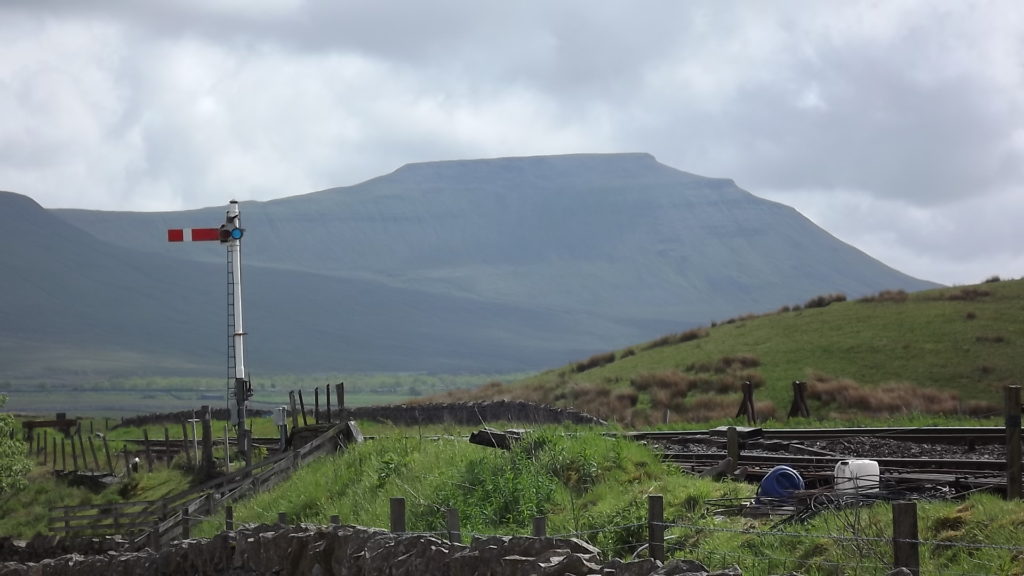
The most scenic route that Tornado is allowed to run on is surely the Settle and Carlisle line. This route incorporates some of northern England’s most dramatic scenery, including long tunnels and high viaducts, all built by muscle power and the sacrifice of an army of railway navvies, few of whom would live past their forties, killed either by accident or their unhealthy alcohol-fuelled lifestyle. 

The drama of the setting on the Settle and Carlisle is enhanced by the display of power shown by Tornado as the locomotive puffs its way up some of the steepest gradients in the country.


The boy who once watched Evening Star
Until its smoke had gone too far
Has never lost that childhood dream
And welcomes back the age of steam
A chance presents to see at last
Mighty Tornado thunder past
He joins the crowd beside the line
To wait the loco’s vanguard sign
A distant whistle tears the air
The rumbling rails tell all: “Prepare!”
Then comes the voice that none can doubt –
The shunt of steam, shout on shout
The pistons’ noise assails in waves
Tornado twists past navvies’ graves
Powering on to climb the height
Affording all a fleeting sight
Of flashing, steaming black and green
A brief, to be remembered, scene
Whistling, pounding screams and wails
Rebound from hills and down the dales
Tornado’s music blasts the ear
A memory of yesteryear


© John Welford